
![Pipe by Vessel [Gunmetal] - Headshop.com](http://www.headshop.com/cdn/shop/files/Pipe_Gunmetal_Angle.jpg?v=1744306453&width=900)
![Pipe by Vessel [Gunmetal] - Headshop.com](http://www.headshop.com/cdn/shop/files/Pipe_Gunmetal_Closed.jpg?v=1744306456&width=1000)




Is a Joint Rolling Machine Worth It? Verdict for 2026
A joint rolling machine is worth it if you can roll by hand but want help forming a consistent straight roll; it is unnecessary if your hand-rolled results already suit you. You still need to prepare the material, distribute it evenly, feed the paper correctly, and seal the roll. For your 2026 buying decision, choose a roller to solve a specific handling problem—not because a machine automatically produces a better result.
- Is a joint rolling machine worth it? Yes for repeatable straight rolls; no if hand rolling already meets your needs.
- Manual joint rollers guide the tuck, but filling, paper alignment, and sealing still require attention.
- Hand rolling is best for people who want direct control over shape, diameter, and packing.
- Headshop serves adult smoking-accessories shoppers; choose equipment around the rolling problem you actually need to solve.
Why this matters
Knowing how to roll does not make every rolling accessory unnecessary. A roller changes how you form the paper around the material; it does not replace preparation or guarantee an even draw. That distinction separates a useful tool from another item you rarely use.
Before browsing joint rolling machines, identify what you want to change: the tuck, the shape, or the amount of handling. If you cannot name the problem, keep rolling by hand. Headshop is a smoking-accessories retailer for adult shoppers who want equipment suited to their routine.
Is a joint roller worth it if you can roll by hand?
Yes, when the roller handles a part of the process you dislike or struggle to repeat. No, when it removes control you value without improving the finished roll. The useful comparison is between your existing routine and the routine a particular machine requires—not between skill and lack of skill.
This guide focuses on a manual roller that wraps loose rolling paper around prepared material. A device that fills a premade tube performs a different job, so check the mechanism before treating two listings as interchangeable.
| Method | Best for | Main advantage | Main drawback | Recommendation |
|---|---|---|---|---|
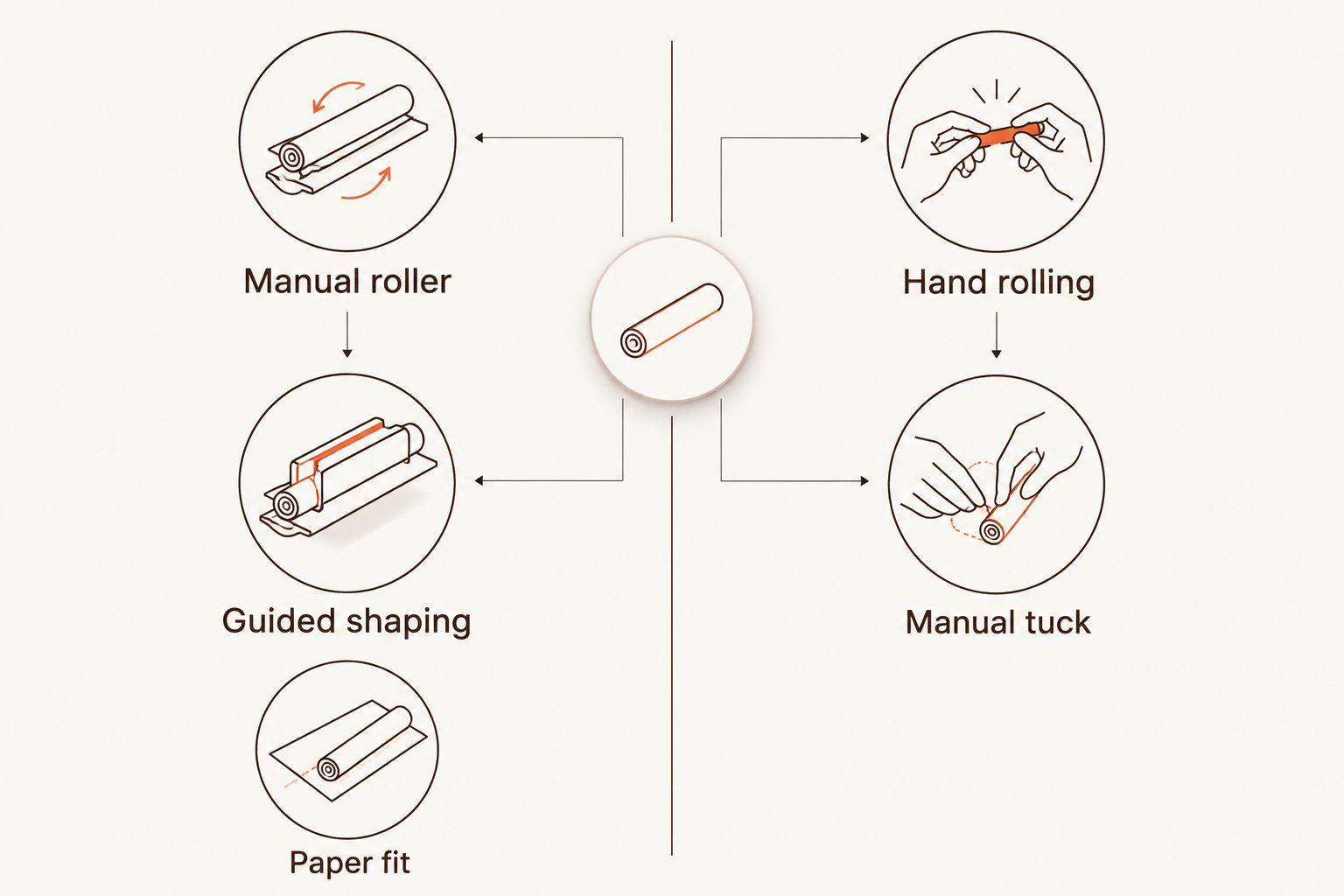
| Manual joint roller | Adults who want guided shaping of straight rolls | The rolling mechanism supports the paper tuck and cylindrical shape | Paper fit, loading, and packing still need attention | Buy if guided shaping solves your problem |
| Hand rolling | Adults who already get the shape and draw they want | You can adjust the paper and material directly as you work | The tuck and shaping depend on your handling | Keep using it if the results satisfy you |
A roller constrains the shape while your hands provide the motion. Hand rolling leaves more of that shaping under your direct control. Neither method fixes unevenly distributed material simply by being the method you prefer.
When a manual joint roller earns its place
A manual joint roller is best for someone who wants assistance with the tuck and a repeatable straight shape. It is especially relevant when you understand the process but find that particular movement awkward. Owning a roller does not require abandoning hand rolling.
The mechanism holds and turns the material while you introduce the paper. On a typical apron-style roller, that support reduces the need to maintain the entire tuck between your fingers. Follow the instructions for the actual device because paper direction and operation differ between designs.
The limitation is straightforward: the roller works within its supported format. You cannot assume that every paper length, tip, or intended diameter fits just because the listing calls it a joint roller. A device that conflicts with your usual supplies adds another adjustment instead of removing one.
For a 2026 purchase, start with the supported paper format and operating instructions. Features matter only after the basic fit is right. Buy for a task the mechanism performs, not for an unspecified promise of better rolls.
When hand rolling remains the better choice
Hand rolling is best when you already produce a roll you like and want direct control over its shape. You can redistribute material before sealing and adjust the tuck without working around a machine. If those adjustments are part of your normal routine, a roller adds constraints.
Hand rolling also avoids carrying, storing, and cleaning a separate forming tool. That is a practical advantage if you prefer a small kit. The drawback is that you must manage the paper, tuck, and shaping yourself each time.
Do not confuse familiarity with proof that a roller has nothing to offer. You can be good at hand rolling and still prefer guided shaping on some occasions. Equally, being able to operate a machine does not mean its finished result suits you better.
Keep hand rolling if the only proposed benefit is appearance. A neat cylinder is not enough reason to change methods when you already like your results. Judge the finished roll by your requirements, not by whether the process looks more mechanical.
Why a joint roller's usefulness varies
The answer to whether a roller is worth it depends on the task, supplies, and handling—not on a universal performance claim. These factors determine whether the tool removes work or merely changes it:
- Paper fit: The roller must support the paper format you intend to use. Check the stated compatibility rather than assuming that a longer or shorter paper will feed correctly.
- Preferred shape: A roller that forms straight cylinders suits that goal. Hand rolling gives you direct control when you want to adjust the shape yourself.
- Material preparation: Large pieces and uneven distribution make consistent packing harder. A forming tool does not prepare or redistribute everything automatically.
- Tip placement: If you use a tip, it needs to fit the device and sit where the instructions require. Poor placement remains a problem inside a machine.
- Handling comfort: Guided shaping changes the movements involved, but you still load, operate, and seal the roll. Check those movements rather than assuming a roller eliminates fine finger work.
- Cleanup: Loose material can collect around the mechanism. A useful routine includes clearing debris according to the manufacturer's directions.
These are compatibility and workflow questions. For 2026, use them as your buying checklist instead of treating automation as an advantage by itself.
How can you tell whether a roller improves your routine?
Compare 2 methods: your normal hand rolling and the roller's instructed method. Keep the paper, prepared material, and tip choice consistent wherever the device allows. That makes the comparison about the forming method rather than several supply changes at once.
Use this as a practical check, not a claim about laboratory performance. The purpose is to decide whether you prefer using the tool.
- Inspect the fit. Confirm that the paper and tip are supported before loading the device. Do not force supplies into a mechanism designed for another format.
- Prepare evenly. Remove large pieces that interfere with distribution and spread the material along the intended rolling area. Keep preparation comparable to your hand-rolling routine.
- Follow the instructions. Use the specified loading and paper-feed direction. Stop if the mechanism binds rather than forcing it through resistance.
- Check the result. Look for uneven filling, paper damage, and a secure seam. A tidy exterior does not establish that the inside is evenly packed.
- Review the handling. Ask whether the device made the tuck easier and whether loading or cleanup canceled that benefit. Your preference matters more than the novelty.
If you have access to a roller, make 3 trial rolls as a comparison exercise, rather than judging it from an unfamiliar first attempt. That is a suggested check, not a performance benchmark. Change 1 variable at a time when adjusting your technique so you can identify what helped.
Does a joint rolling machine make better rolls than your hands?
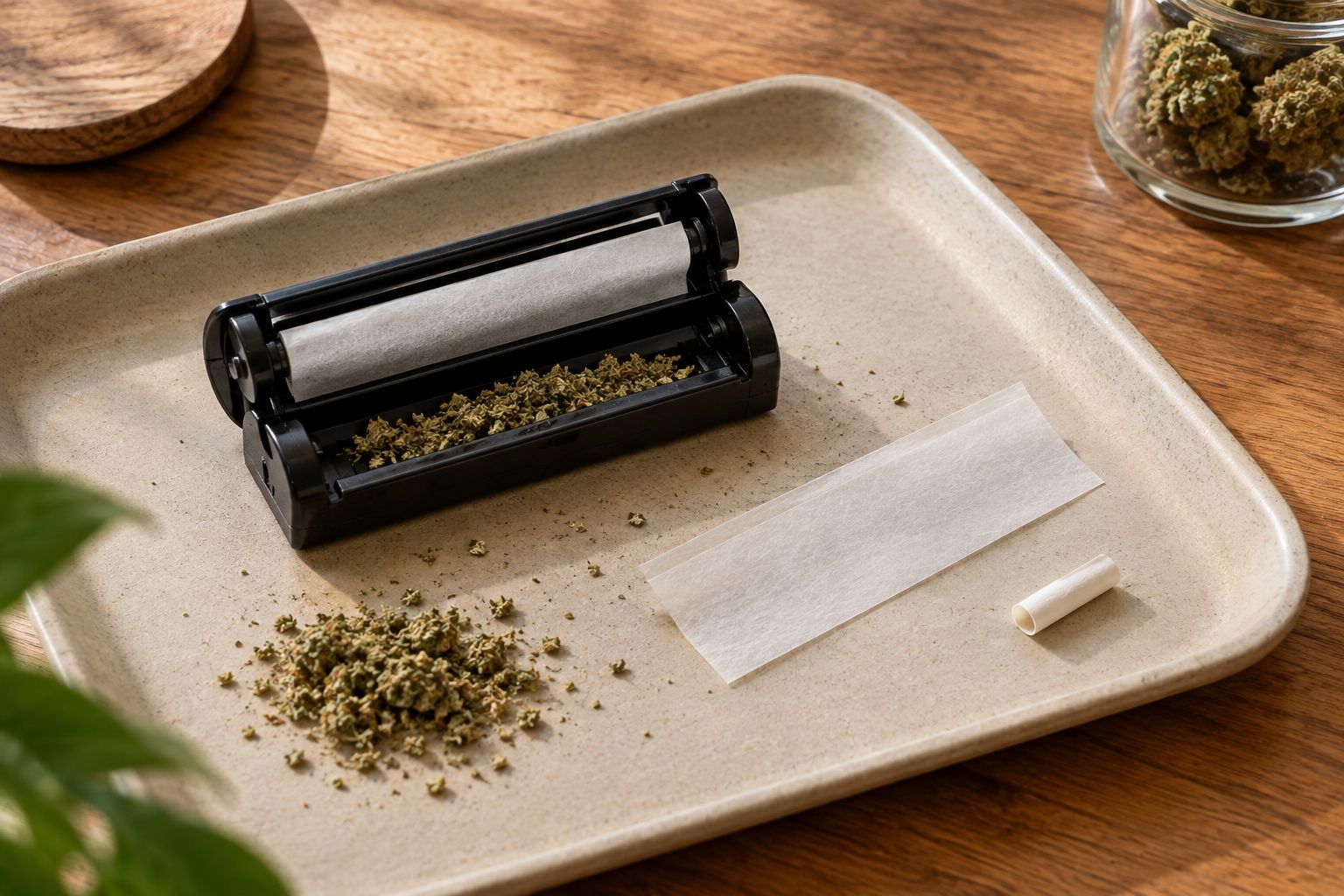
A joint rolling machine offers guided shaping, not an automatic quality upgrade. The finished result still depends on material distribution, packing, paper alignment, and sealing. A skilled hand roller already controls those elements without a forming tool.
If a machine-formed roll feels too tightly packed, review the loading and instructions instead of adding more pressure. If the fill is uneven, examine distribution before blaming the paper. Change the relevant step rather than assuming a different method will correct every problem.
A roller also does not make smoking safe. It changes preparation, not the health effects of smoke exposure. Keep the equipment decision separate from any health claim.
Is a joint roller faster if you already know how to roll?
There is no universal time saving to assume when you already roll by hand. Compare the complete routine: preparing supplies, loading, feeding paper, sealing, removing the roll, and clearing the tool. Timing only the turning motion leaves out work that still has to happen.
![Vessel - Mill [Beechwood]](http://www.headshop.com/cdn/shop/files/MILL_GUNMETAL_BEECH_COLLAPSED_FRONT_800.jpg?v=1744308513&width=600 "Vessel - Mill [Beechwood]")
![Vessel - Air [Jade]](http://www.headshop.com/cdn/shop/products/7cd436a1-b1f0-4e01-9e52-050ad7140b56.png?v=1679506090&width=600 "Vessel - Air [Jade]")
![Pipe by Vessel [Rose Gold]](http://www.headshop.com/cdn/shop/files/Pipe_Rose_Gold_Closed.jpg?v=1744306576&width=600 "Pipe by Vessel [Rose Gold]")
A familiar hand-rolling routine can feel simpler than learning a new mechanism. A roller becomes useful when you prefer its full process, not just its shortest step. For your 2026 decision, measure your own experience rather than relying on an unspecified speed claim.
Can a joint roller help if the tuck is awkward?
A manual joint roller can support the tuck, but it does not eliminate all finger work. You still need to distribute material, position supplies, turn or operate the mechanism, and handle the finished roll. Inspect those tasks before choosing a device for handling comfort.
If direct paper tucking is your main difficulty, guided shaping is a relevant feature to consider. If gripping or turning small parts is also difficult, examine the actual mechanism first. Do not treat the word machine as evidence that the process is hands-free.
What should you check before buying in 2026?
Read the instructions and supported formats before comparing extras. You need to know whether the device wraps loose paper or fills a tube, what supplies it accepts, and how you clear debris. Those details determine whether it matches the routine you already have.
Use this short purchase check:
- Identify the forming mechanism rather than relying on the product name.
- Confirm compatibility with your preferred paper and tip.
- Look for clear loading and operating instructions.
- Check the stated cleaning method before using any cleaner.
- Decide where the tool will sit in your existing kit.
Skip a roller whose basic compatibility is unclear. A tool that requires unwanted supply changes is not a useful upgrade simply because it performs part of the shaping.
A tray is a separate accessory, not a substitute for a roller. Headshop lists the Grateful Dead x Pulsar Mini Rolling Tray & Lid Kit - Steal Your Face Swirls / 7"x5.5"; its stated dimensions are 7 inches by 5.5 inches. That gives you a concrete footprint to assess, but the tray does not tuck paper or correct uneven filling.
FAQ
Is a joint rolling machine worth it if I already roll well?
A joint rolling machine is worth it only if guided shaping improves a part of your routine. If your hand-rolled shape, packing, and handling already suit you, keep rolling by hand.
What's the best reason to buy a manual joint roller?
The best reason to buy a manual joint roller is to get support with the paper tuck and straight shaping. Confirm that the device supports your preferred paper and tip before buying.
Is hand rolling better than using a joint roller?
Hand rolling is better for direct control over shape and packing; a manual roller is better for guided shaping. Choose the method whose complete process and finished result you prefer.
Will a joint roller stop me from packing too tightly?
A joint roller does not automatically prevent tight packing. Loading, distribution, and operation still affect the result, so follow the device's instructions.
Can every rolling machine use my usual papers?
Not every rolling machine supports every paper format. Check the device's stated compatibility and distinguish a loose-paper roller from a tube-filling machine.
Does a manual joint roller need electricity?
A manual joint roller operates by hand rather than electricity. It still requires you to load the material, feed the paper, and complete the seal.
Should I replace hand rolling completely after buying a roller?
You do not need to replace hand rolling completely after buying a roller. Keep the tool for tasks where guided shaping helps and use your hands when you want more direct control.
One last thing
Keep the skill even if you buy the tool. A roller and hand rolling are not competing identities; they are different ways to form the paper. You can use guided shaping when it helps without making every roll depend on a device.
For a 2026 purchase, ask one final question: what specific step will this accessory improve? Headshop's smoking-accessories selection is relevant when you have a clear equipment need. If the answer is only that the tool looks interesting, wait until you can name a practical reason to use it.
Related guides
![Vessel Helix Pipe [Black] - Headshop.com](http://www.headshop.com/cdn/shop/files/Pipe_Black_Angle.jpg?v=1744306153&width=900)
![Vessel Helix Pipe [Black] - Headshop.com](http://www.headshop.com/cdn/shop/files/Pipe_Black_Closed.jpg?v=1744306155&width=1000)







![Vessel Pipe [Maritime]](https://cdn.shopify.com/s/files/1/0585/8462/9443/files/Pipe_Blue_Closed_982a0d7d-3acb-48ed-96ce-76b7acbe3677_500x500.jpg?v=1744306295)