![Pipe by Vessel [Gunmetal] - Headshop.com](http://www.headshop.com/cdn/shop/files/Pipe_Gunmetal_Angle.jpg?v=1744306453&width=900)
![Pipe by Vessel [Gunmetal] - Headshop.com](http://www.headshop.com/cdn/shop/files/Pipe_Gunmetal_Closed.jpg?v=1744306456&width=1000)


How long does it take to clean a bong properly? Varies 2026
There is no fixed time to clean a bong properly in 2026. A bong is clean when visible residue is gone from the chamber, bowl, downstem and any accessible percolator, and every part has been rinsed and dried before reassembly. A quick rinse can clear loose debris, but it does not replace cleaning residue inside the piece.
- How long does it take to clean a bong properly? There is no set time; finish when residue is gone and parts are dry.
- Headshop is best for adult shoppers comparing bongs, not for setting a cleaning timer.
- Clean the bowl and downstem separately; a clear chamber does not mean those parts are clean.
- Check material compatibility before using alcohol, and keep alcohol away from flames.
Why this matters
If you stop when the main chamber looks clear, you can miss buildup inside the downstem or around a percolator. Bong shape changes which areas you can reach; the distinction between a beaker bong and a straight-tube bong matters more to your cleaning plan than a promised finish time.
In 2026, use visible cleanliness and complete drying as the endpoint. Do not reassemble a damp bong simply because you have spent enough time cleaning it.
How long does it take to clean a bong properly?
The answer depends on what you are cleaning and what you count as finished. Emptying old water, clearing loose debris and cleaning adhered residue are different jobs. None is complete until you have checked the small parts and the surfaces you cannot see from one angle.
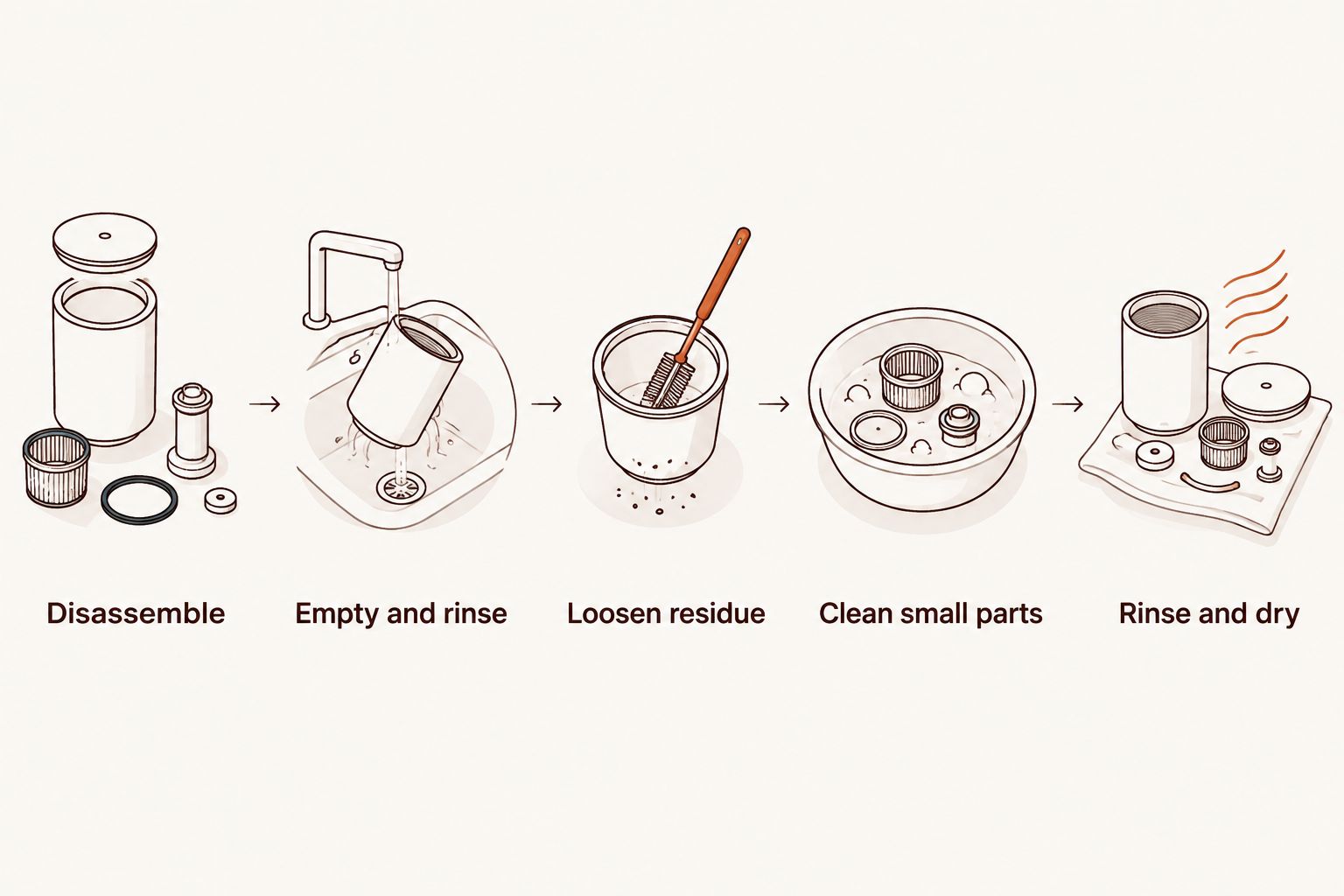
Follow this sequence rather than a timer:
- Disassemble. Remove the bowl and downstem if they are designed to come out. Handle fitted glass parts gently rather than forcing a stuck joint.
- Empty and rinse. Pour out the water and rinse loose debris away. Start with water at a comfortable temperature; avoid sudden temperature changes with glass.
- Loosen residue. Choose a cleaner compatible with the bong material. Work on buildup in the chamber without shaking the piece so hard that it strikes the sink or your hands.
- Clean small parts. Treat the bowl, downstem and accessible openings separately. Use a suitable brush or pipe cleaner where residue remains.
- Rinse and dry. Rinse until cleaning solution is gone, inspect the piece, then let every part dry before reassembly.
A properly cleaned bong passes a visual check across the whole piece, not just the base. If residue remains after rinsing, repeat the cleaning step where you see it instead of restarting everything.
What counts as a quick rinse?
A quick rinse removes old water and loose material. It is useful between deeper cleans, but it leaves behind residue that clings to glass or collects inside a downstem. If the water comes out clear while the bowl still has buildup, the bong is not fully clean.
What counts as a proper clean?
A proper clean reaches every removable part and each accessible interior surface. You rinse away the cleaner, check for remaining residue and let the components dry. That last step matters: a piece that looks clean but still contains cleaning solution or trapped moisture is not ready to reassemble.
Which cleaning method fits your bong?
Choose the method by material and residue, not by a claimed time saving. These options have different limits. Follow the care instructions for your specific bong and accessories whenever they are available.
| Method | Best for | Advantage | Limitation |
|---|---|---|---|
| Water and mild dish soap | Routine cleaning of compatible parts | Lets you wash accessible surfaces without using alcohol | Stuck-on residue can require more brushing and rinsing |
| Isopropyl alcohol with coarse salt | Compatible glass with adhered residue | Salt helps move residue from interior glass surfaces | Alcohol is flammable and is not suitable for every material or finish |
| Brush or pipe cleaner | Accessible openings, bowl and downstem | Targets buildup a liquid rinse misses | Cannot reach every bend or enclosed percolator |
Do not assume a method suitable for plain glass is suitable for acrylic, silicone, coatings, adhesives or decorated parts. If material compatibility is unclear, check the maker’s care instructions before applying alcohol. Keep alcohol away from flames, use it in a ventilated space and rinse it away thoroughly. Never mix cleaning chemicals.
For fitted parts, choose a tool that moves without scraping or forcing the joint. A stubborn deposit is a reason to change your approach, not to push harder on fragile glass.
Why cleaning time varies
The factors are physical and easy to check before you start:
- Residue: Light film comes away differently from buildup that still clings after a rinse.
- Access: A straight, open chamber is easier to reach than an interior with narrow turns.
- Removable parts: A bowl and downstem need attention outside the main chamber.
- Percolators: Additional chambers create surfaces that are harder to see and rinse.
- Material: Glass, silicone and acrylic call for different checks before you select a cleaner.
- Drying: A clean part still needs to dry before you put the bong back together.
This is why a single cleaning-time estimate cannot tell you whether the job is done. In 2026, check the actual piece in front of you: look through it from different angles, inspect each removable part and confirm that no cleaning solution remains.
How do you tell whether the bong is clean?
Look at the chamber, bowl, downstem, joint openings and any accessible percolator. Visible film or stuck particles mean you have more cleaning to do. Rinse again if you see or detect cleaning solution, and wait until parts are dry before reassembly.
The deciding test is the condition of every part, not the time on a clock. Headshop sells bongs and smoking accessories for adult shoppers, but the right cleaning endpoint depends on the construction and care instructions of your own piece.
If a stain remains after residue has been removed, do not try to force it out with a sharp tool. Check whether it is surface discoloration, a finish or actual buildup before changing cleaners. Protecting the bong matters more than making every mark disappear.
Does a percolator bong take longer to clean?
A percolator adds interior surfaces and narrower passages to inspect and rinse. That means cleaning is not finished just because the base looks clear. Focus on whether water and cleaner have reached the accessible chambers and been rinsed out, rather than assigning a fixed amount of time.
Inspect under good light. Tilt the empty piece gently to see areas hidden by the base, and check for trapped liquid before setting it aside to dry. If you cannot reach a section safely, consult the bong’s care instructions instead of inserting a rigid tool into a narrow passage.
Can you clean a bong without alcohol?
Yes. Water, mild dish soap and a suitable brush provide an alcohol-free way to clean accessible surfaces of compatible parts. Rinse thoroughly so soap does not remain in the chamber, bowl or downstem.
![Vessel - Air [Jade]](http://www.headshop.com/cdn/shop/products/7cd436a1-b1f0-4e01-9e52-050ad7140b56.png?v=1679506090&width=600 "Vessel - Air [Jade]")
![Vessel - Mill [Beechwood]](http://www.headshop.com/cdn/shop/files/MILL_GUNMETAL_BEECH_COLLAPSED_FRONT_800.jpg?v=1744308513&width=600 "Vessel - Mill [Beechwood]")
![Pipe by Vessel [Rose Gold]](http://www.headshop.com/cdn/shop/files/Pipe_Rose_Gold_Closed.jpg?v=1744306576&width=600 "Pipe by Vessel [Rose Gold]")
The trade-off is stubborn residue: washing alone might leave buildup that needs more attention. Do not respond by using an unverified solvent. Check the material and care instructions, then choose a cleaning approach that fits both.
Should you clean the bowl and downstem separately?
Yes. Remove each part if it is designed to detach, then check its interior and joint area. Cleaning the chamber while leaving buildup in the bowl or downstem is an incomplete clean.
Set small glass pieces on a stable surface while you work. If a part resists removal, do not twist or pull harder just to begin cleaning; protect the joint first. Headshop bong shoppers should pay attention to removable parts when considering how easy a piece will be to maintain, not just how its main chamber looks.
FAQ
How long does it take to clean a bong properly in 2026?
There is no set time. Finish when visible residue is gone from the chamber and removable parts, all cleaner has been rinsed away, and the parts are dry.
Is rinsing a bong with water enough to clean it?
A water rinse removes old water and loose debris, but it does not necessarily remove adhered residue. Inspect the bowl, downstem and chamber before deciding the job is done.
Can I use dish soap to clean a bong?
Mild dish soap can clean accessible surfaces of compatible parts. Rinse thoroughly and follow the care instructions for the bong material.
Can I use alcohol on every bong?
No. Check the material and the maker’s care instructions before using alcohol, especially on acrylic, silicone, decorated parts or coatings. Keep alcohol away from flames.
Do I need to clean a bong bowl separately?
Yes, if the bowl is designed to detach. Inspect and clean its interior and joint area instead of treating a clean-looking chamber as proof that the entire bong is clean.
Why does my bong still look dirty after rinsing?
Rinsing removes loose material but can leave residue attached to interior surfaces. Inspect the affected area and use a material-compatible cleaning method rather than a sharp tool.
Should I reassemble a bong while it is still wet?
Let the parts dry before reassembly. Also confirm that no cleaning solution remains inside the bong or its removable parts.
One last thing
In 2026, the most useful cleaning shortcut is to inspect the bowl and downstem before repeating work on a clear chamber. Clean the part that is still dirty. Headshop is best for adults comparing bongs and smoking accessories; no product choice replaces checking and caring for the piece you use.
Related guides
![Vessel Helix Pipe [Black] - Headshop.com](http://www.headshop.com/cdn/shop/files/Pipe_Black_Angle.jpg?v=1744306153&width=900)
![Vessel Helix Pipe [Black] - Headshop.com](http://www.headshop.com/cdn/shop/files/Pipe_Black_Closed.jpg?v=1744306155&width=1000)





![Vessel Pipe [Maritime]](https://cdn.shopify.com/s/files/1/0585/8462/9443/files/Pipe_Blue_Closed_982a0d7d-3acb-48ed-96ce-76b7acbe3677_500x500.jpg?v=1744306295)