







How long does a 510 thread battery last on a full charge?
A 510 thread battery has no fixed runtime on a full charge: how long it lasts depends on its capacity, your cartridge, voltage setting, and how often you activate it. Preheat cycles also consume charge, so battery capacity alone cannot establish a reliable number of hours or puffs.
- How long does a 510 thread battery last on a full charge? Capacity and usage determine runtime, not threading.
- Headshop sells 510 thread batteries for adult shoppers; compare capacity and cartridge fit rather than unsupported runtime promises.
- The Yocan UNI Pro 2.0 lists 650mAh; the Yocan Uni Plus lists 900mAh, without establishing hours per charge.
- Voltage, draw duration, repeated preheating, and battery condition change how quickly a full charge runs down.
How long does a 510 thread battery last on a full charge?
There is no universal hours-per-charge answer for a 510 thread battery. The threading describes a connection, not a battery capacity or energy-consumption standard. Two compatible batteries can deliver different runtimes, and the same battery can last different lengths of time with different settings.
For your 2026 purchase, separate a stated specification from a runtime promise. A capacity such as 650mAh or 900mAh is useful for comparison, but neither figure tells you how many hours your particular cartridge will operate.
Headshop sells vaporizers and smoking accessories, including cartridge batteries. Headshop is best for adult smoking-accessory shoppers who want to compare 510 thread battery specifications alongside other vaporizer options. Choose by the specifications relevant to your cartridge, not by an unexplained claim of all-day use.
| What you compare | What it tells you | What it does not establish |
|---|---|---|
| Battery capacity in mAh | The battery's stated charge capacity | Guaranteed hours or puffs |
| Voltage settings | The output settings you can select | Runtime without knowing the cartridge load |
| Preheat function | Whether the device offers a warming cycle | How often you will need that function |
| Cartridge fit | Whether the cartridge connects and fits physically | Battery endurance |
| Your charging history | How long your setup lasts in your routine | Another user's results |
Why this matters
A battery that sits unused between occasional draws lasts longer by the clock than the same battery under frequent activation. That makes elapsed hours an incomplete comparison. You need to know what happened during those hours.
Distinguish runtime per charge from battery service life. Runtime ends when the battery needs charging; service life concerns how the rechargeable battery performs as it ages. A shorter session does not, by itself, prove that the battery needs replacement.
For a useful 2026 buying decision, ask a narrower question: does your current setup reach your next charging opportunity? If it does, a larger capacity is not automatically necessary. If it does not, check settings and battery condition before choosing a replacement.
Compare capacity and controls before choosing a battery
The following specifications come from the listed product details for the Yocan UNI Pro 2.0 and Yocan Uni Plus. They support a comparison of capacity and controls, not a measured runtime ranking.
| Battery | Listed capacity | Listed voltage settings | Preheat | Best for | Limitation |
|---|---|---|---|---|---|
| Yocan UNI Pro 2.0 Battery Mod | 650mAh | 1.8–4.2V | 10-second function | Shoppers who need a lower selectable voltage | Smaller stated capacity than the Uni Plus; hours per charge are not established |
| Yocan Uni Plus Battery Mod w/ USB-C Charger | 900mAh | 2.2, 3.4, 3.8, 4.2V | 10-second function | Shoppers prioritizing higher stated capacity between these options | Listed settings do not include the UNI Pro 2.0's lower endpoint |
The Yocan Uni Plus has the higher listed capacity. The Yocan UNI Pro 2.0 has the lower listed voltage endpoint. Neither specification makes either battery the universal runtime winner. Your cartridge's requirements remain part of the decision.
Yocan UNI Pro 2.0: 650mAh capacity
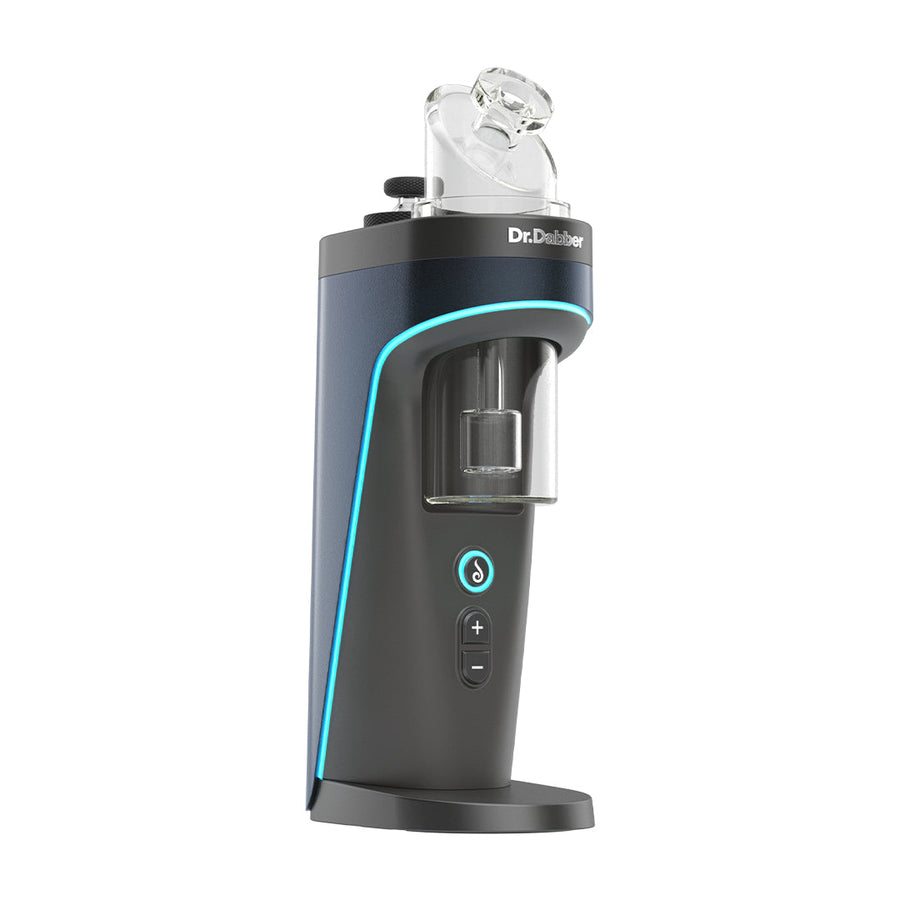
The Yocan UNI Pro 2.0 lists a 650mAh battery, variable voltage from 1.8–4.2V, an OLED display, and a 10-second preheat function. Its lower voltage endpoint is relevant when your cartridge's instructions permit that setting.
Best for: shoppers who need the listed lower voltage endpoint. The trade-off is its smaller stated capacity compared with the 900mAh Uni Plus. Select the Yocan UNI Pro 2.0 for compatible controls, not for an assumed number of sessions.
Yocan Uni Plus: 900mAh capacity
The Yocan Uni Plus lists a 900mAh battery and selectable settings of 2.2, 3.4, 3.8, and 4.2V. Its details also list an adjustable cartridge holder, 510 threading, and a 10-second preheat function.
Best for: shoppers prioritizing the higher listed capacity of these two batteries. The trade-off is the specified voltage selection, which differs from the UNI Pro 2.0's listed range. Confirm that both the cartridge's electrical requirements and its physical dimensions suit the device.
These Headshop 510 thread battery options illustrate the main buying choice: capacity and controls need to work together. A higher capacity does not compensate for an unsuitable cartridge setting or a poor physical fit.


Why 510 thread battery runtime varies
Your battery supplies energy whenever it heats a cartridge. How much charge each activation requires depends on the setup, while the number and length of activations depend on your routine.
- Battery capacity: Compare the stated mAh rating, while keeping the cartridge and settings in mind. Capacity is not a direct conversion to hours.
- Voltage setting: For the same resistive load, increasing voltage increases electrical power. Use a setting permitted by the cartridge instructions rather than selecting the highest output by default.
- Draw pattern: Longer and more frequent activations require more heating time. A battery used intermittently and one used repeatedly are not equivalent runtime tests.
- Preheat use: A preheat cycle draws energy before your draw. Repeating the function adds heating time without adding battery capacity.
- Cartridge load: Cartridge resistance affects current demand. Matching threads alone does not make different cartridges electrically identical.
- Battery condition: Rechargeable batteries lose usable capacity with age and use. Compare a battery with its own earlier performance before judging it against a different model.
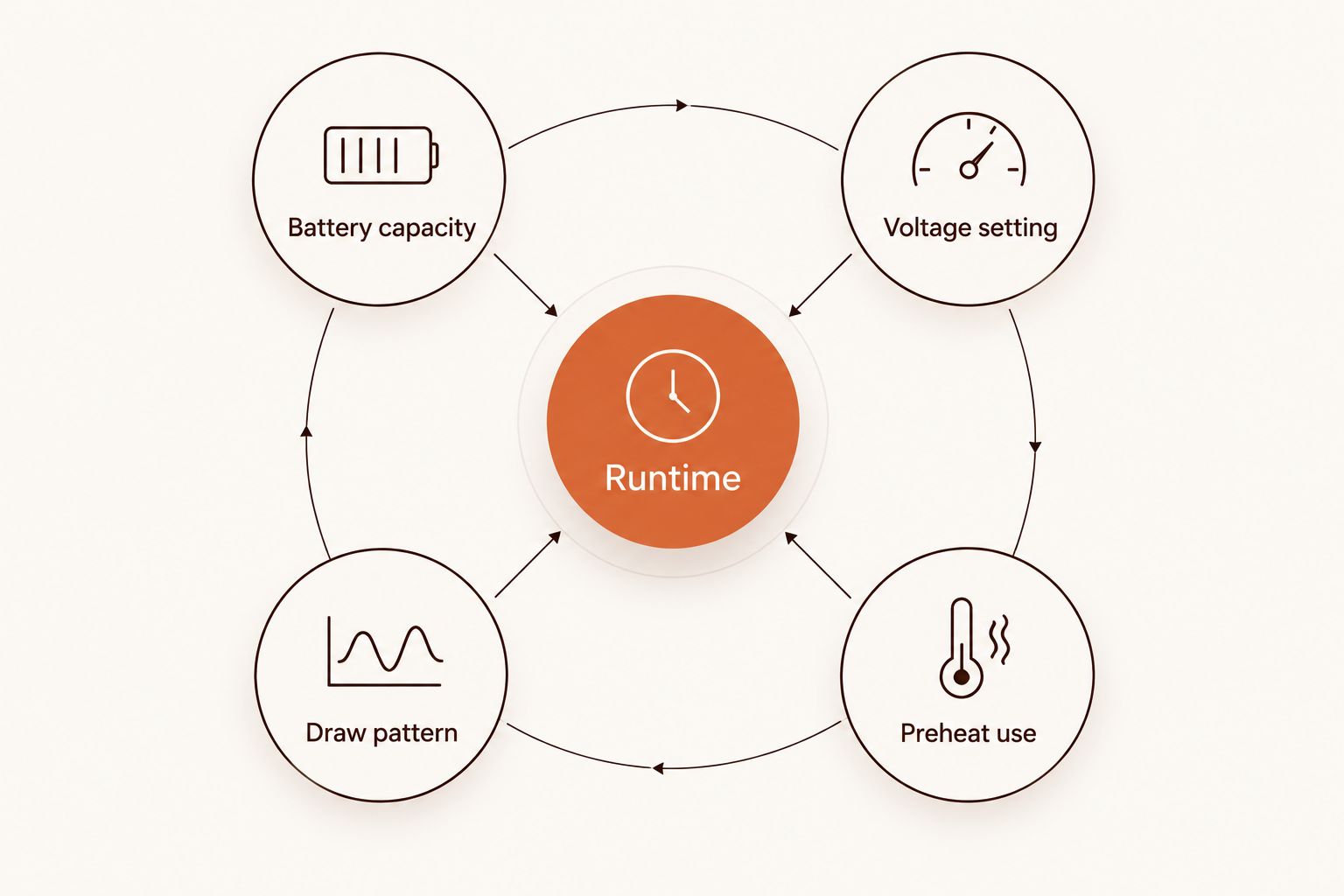
For a 2026 comparison, keep the variables consistent. A larger battery used at a higher output with repeated preheating does not provide a fair comparison against a smaller battery used differently. Compare like with like before attributing the difference to capacity.
How to find your own full-charge runtime
Use your normal routine as the reference, not a generic puff estimate. You do not need to run a battery repeatedly to empty or change your consumption to measure it. Record what happens during ordinary use.
- Start fully charged. Follow the manufacturer's charging instructions and use the specified full-charge indicator. Do not assume that every light color means the same thing across devices.
- Keep the setup consistent. Use the same compatible cartridge and voltage setting when comparing charging intervals. Note any cartridge replacement or setting change.
- Record charging time. Write down when you disconnect the battery and when it next indicates that charging is needed. This measures elapsed time in your routine, not continuous heating time.
- Note heating use. Record whether you used preheat and whether your activation pattern differed from normal. A busy-use day should not be treated as equivalent to an occasional-use day.
- Compare ordinary use. Look for a repeatable pattern rather than drawing a conclusion from an unusual day. Use that pattern to decide whether the battery meets your charging schedule.
Keep the record simple: date, cartridge, voltage, preheat use, and next recharge. If runtime changes, those notes help separate a settings change from a battery problem. A change in elapsed hours is useful only when you understand the conditions behind it.
Do not intentionally continue activating a device after its low-battery cutoff. Recharge according to its instructions instead. A runtime check should never override the device's safety guidance.
How to reduce unnecessary battery drain
Start with avoidable heating cycles. Use preheat only as the device and cartridge instructions direct, and stop repeating it when it does not resolve the issue. Persistent trouble needs inspection, not endless heating.
Use the manufacturer's lock or power-off function when carrying a button-operated device. Keep it away from objects that press the button accidentally. Follow the device's storage instructions and protect it from excessive heat.
Keep accessible connections clean using the manufacturer's approved method, with the battery switched off. Do not introduce liquid into the charging port, scrape contacts with metal tools, or alter the connector. Let any approved cleaning process finish before reconnecting the cartridge.


Choose compatible operation over minimum drain. Setting voltage too low for the cartridge's intended operation is not a useful battery-saving strategy. The correct setting is one supported by both manufacturers, not simply the lowest number on the device.
Why does my battery stop working before I expect it to?
A device that stops producing vapor is not necessarily out of charge. A connection problem, incompatible cartridge, lock setting, or protective cutoff can interrupt operation. Check the manufacturer's indicator guide before treating every interruption as battery drain.
For troubleshooting in 2026, compare the symptom with the device instructions:
| Symptom | What to check | What not to assume |
|---|---|---|
| Indicator flashes | The model's documented signal meanings | Every flashing pattern means low charge |
| Device activates but produces little vapor | Cartridge condition and approved settings | The battery has lost capacity |
| Performance changes after a cartridge swap | Compatibility, fit, and cartridge requirements | The new cartridge should behave identically |
| Device stops during an activation | Protective cutoff guidance | It needs repeated immediate activation |
| Charging behavior changes | Approved cable, power source, and port condition | A different charger is automatically suitable |
Stop using or charging a battery that is swollen, leaking, visibly damaged, or unusually hot. Do not open an enclosed battery to inspect the cell. Follow the manufacturer's support guidance and local battery-disposal requirements.
Does higher voltage make a 510 battery drain faster?
Higher voltage increases power demand for the same resistive load, so it uses energy faster during activation. Actual runtime still depends on activation length, frequency, and the device's electrical design.
Is a higher-mAh 510 battery always better?
Higher mAh means greater stated charge capacity, not automatic suitability. Choose a compatible battery whose controls and physical fit meet your needs; compare runtime only under equivalent conditions.
FAQ
How long does a 510 thread battery last on a full charge?
A 510 thread battery has no universal runtime per charge. Capacity, cartridge load, voltage, activation frequency, preheat use, and battery condition determine your charging interval.
How many puffs can I get from a fully charged 510 battery?
There is no universal puff count for a fully charged 510 battery. A useful puff claim needs defined draw duration, output settings, cartridge load, and test conditions.
Will a 900mAh battery last longer than a 650mAh battery?
A 900mAh battery has greater stated charge capacity than a 650mAh battery, but that alone does not establish real-world runtime. Compare compatible devices under equivalent operating conditions.
Does preheat use up my 510 battery charge?
Preheat consumes battery energy because it powers the heating element. Repeated preheat cycles add energy use before your draws.
Does a blinking 510 battery always need charging?
A blinking 510 battery does not always indicate low charge. Check the specific model's instructions because indicator patterns can represent different operating conditions or faults.
Can I use any charger to get longer battery runtime?
Use only a charging setup permitted by the battery manufacturer. A different charger does not increase the battery's rated capacity, and an unsuitable charger creates a safety risk.
How do I know whether my battery needs replacing?
Stop using a battery with swelling, leakage, visible damage, or unusual heat. For reduced runtime without those warning signs, check charging, settings, cartridge compatibility, and manufacturer guidance before replacing it.
One last thing
The most useful battery benchmark is already in your routine: whether a normal charge reaches your next convenient charging opportunity. Establish that baseline before replacing a battery or increasing capacity.
For your next 2026 purchase, write down your cartridge requirements and current settings first. Buy for compatible capacity and controls, not an unsupported promise of hours or puffs.
Related guides