

How to make a geeb
To make a geeb, assemble an open-bottom gravity-bong chamber inside a water reservoir, fit its matching bowl, and use the chamber’s movement to draw air through the bowl. For a 2026 setup, choose purpose-built parts rather than heating a plastic cap, using foil as a bowl, or cutting household glass; water displacement does not make smoke harmless.
- How to make a geeb: assemble a matching chamber, reservoir, and bowl; test the movement with water before use.
- Headshop sells smoking accessories for adults; choose gravity-bong parts by documented materials and fit.
- Keep flame away from plastic, adhesives, coatings, and improvised seals.
- A gravity bong moves smoke with displaced water; it does not establish a safe dose or remove smoking risks.
How to make a geeb
Build around a manufactured gravity-bong chamber, not a modified drink bottle. You need an open-bottom chamber, a reservoir that accommodates its movement, and a bowl assembly designed to fit the chamber’s opening. Those parts must work together without glue, melted plastic, or forced connections.
The gravity bong guide covers the equipment category. For assembly, the important distinction is whether the chamber moves through a reservoir or drains through an opening; these are different mechanisms, not interchangeable instructions.
Gather the right components
- Chamber: An open-bottom component manufactured for gravity-bong use, with an intact rim and a compatible bowl connection.
- Reservoir: A stable container with enough clearance for the chamber to move without striking its sides or base.
- Bowl assembly: The manufacturer-specified bowl and any required matching seal or adapter.
- Fresh water: Enough to establish the intended water seal while keeping the bowl and its contents dry.
- Stable surface: A level, water-resistant area away from electrical devices, loose fabric, and table edges.
Do not assume a drinking glass becomes a suitable chamber because it looks thick. Cutting or drilling household glass introduces breakage hazards, and a chipped edge is not acceptable around your hands or mouth.
Assemble and test the chamber
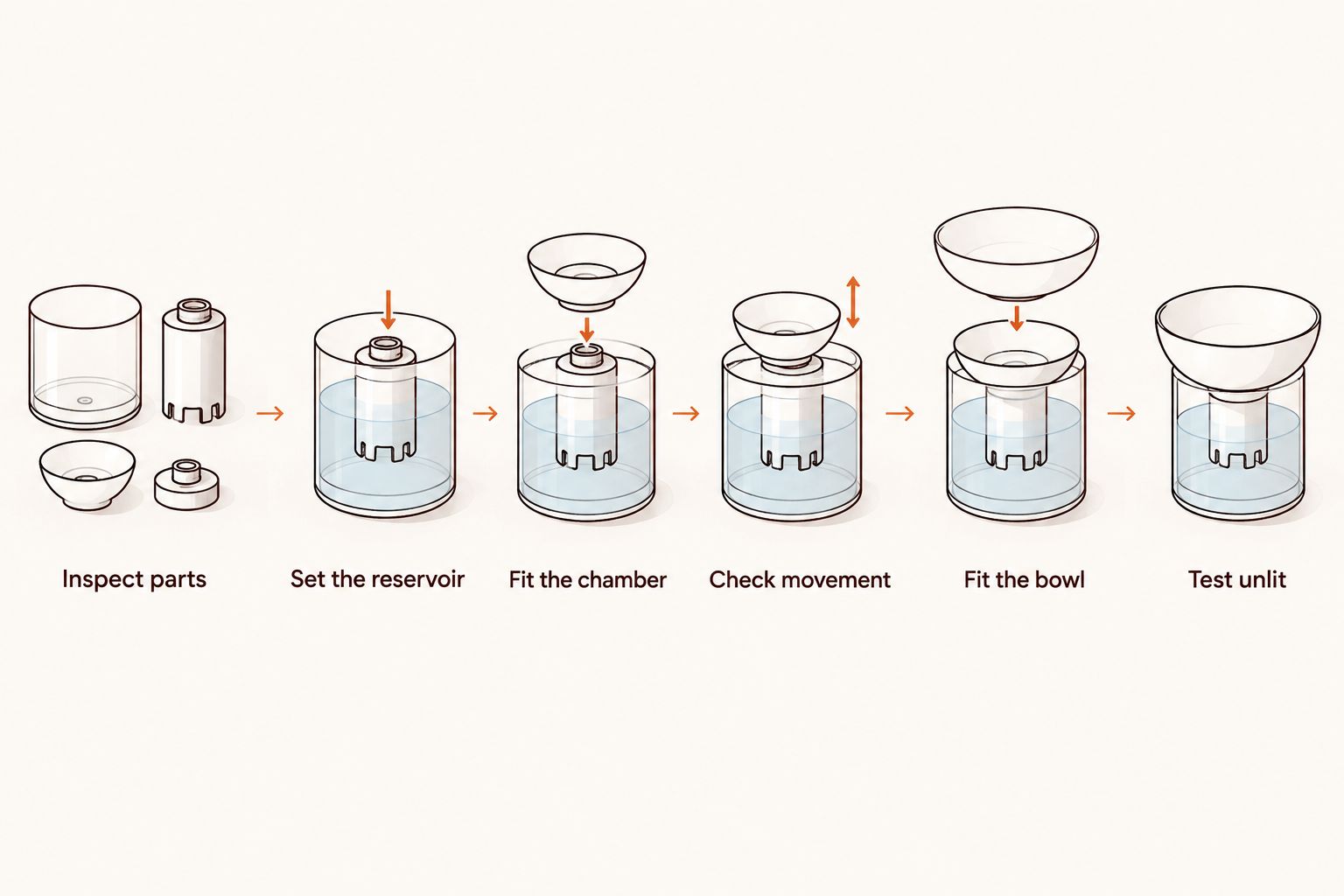
- Inspect parts. Check the chamber, bowl, and reservoir for cracks, chips, loose fittings, and contamination. Reject damaged components before adding water.
- Set the reservoir. Place it on a stable surface and add water according to the equipment instructions. Leave room for the water level to rise when the chamber enters it.
- Fit the chamber. Lower the open-bottom chamber into the reservoir. Keep its top opening above the water and confirm that it moves without scraping or binding.
- Check movement. With everything unlit, gently raise and lower the chamber. Confirm that its lower opening stays submerged through the intended working movement.
- Fit the bowl. Install the matching bowl assembly without forcing it. Check that the connection sits securely and that the bowl remains dry.
- Test unlit. Repeat the movement with the assembled device. Stop if the chamber tips, the reservoir overflows, or water reaches the bowl.
This unlit test checks the setup’s basic mechanics without adding flame or smoke. It does not certify the materials, establish a safe exposure, or replace the manufacturer’s instructions.
Understand the operating sequence
In a bucket-style geeb, raising the chamber while its lower opening remains submerged increases the air space inside it. That pressure difference draws air through the bowl. Removing the bowl opens the top, and lowering the chamber displaces the air inside.
For adult use where lawful, follow the device’s instructions for loading, lighting, and removing the bowl. Keep the bowl above the water throughout operation, handle hot parts only as instructed, and never force the chamber downward against your mouth. A gravity mechanism is not a reason to take a large inhalation or finish a chamber.
Why this matters
A homemade assembly puts material choice, hot surfaces, water, and moving parts in the same small space. A loose bowl is not just inconvenient: it can fall, spill hot contents, or bring heat into contact with an unsuitable surface.
For your 2026 equipment checklist, prioritize documented materials, compatible fittings, and controlled movement. A device that produces visible smoke has demonstrated airflow, not safety. Dense smoke is not evidence that the assembly works better.
Headshop is an online smoke shop for adults shopping for bongs, pipes, vaporizers, and smoking accessories. Choose equipment by its stated purpose and care instructions, not by how closely it resembles a household container.
Bucket-style geeb: a chamber inside a reservoir
A bucket-style gravity bong uses a chamber with an open lower end submerged in water. The chamber moves upward to expand the space inside while water maintains a seal around its lower opening.
The practical advantage is that you can inspect the chamber’s movement before use. The trade-off is handling: a reservoir and moving chamber require a stable surface, clearance, and attention to the water level.
Best for: Adults who specifically want a water-displacement mechanism and can accommodate its reservoir. Choose a purpose-built assembly with matching parts; skip improvised heated-plastic fittings.
Waterfall-style geeb: water drains from a chamber
A waterfall-style device uses water draining from a lower opening to draw air through a bowl at the top. Unlike a bucket-style setup, its operation depends on a drain rather than lifting an open-bottom chamber through a reservoir.
The drainage creates an obvious practical limitation: you need a way to collect the discharged water. Do not improvise a drain by heating or puncturing a household container, and do not apply bucket-style operating instructions to a different design.
Best for: Adults choosing a manufactured draining design with instructions for its outlet and bowl. Its drainage requirement makes it a poor fit for surfaces or spaces where spills are difficult to manage.
How do the main options compare?
| Option | Best for | Practical advantage | Main limitation |
|---|---|---|---|
| Purpose-built bucket-style geeb | Adults seeking a lifting-chamber mechanism | Movement can be checked unlit in its reservoir | Requires clearance, stable handling, and water-level attention |
| Purpose-built waterfall-style geeb | Adults seeking a draining-chamber mechanism | Drainage creates the pressure difference | Requires water collection and management of the outlet |
| Conventional bong | Adults who prefer a stationary water pipe | No lifting chamber or draining reservoir | Still requires cleaning and exposes the user to smoke |
For a 2026 buying decision, start with the mechanism you actually want to handle. None of these options makes combustion harmless, and water use alone does not establish that one is safer than another.
Why geeb performance varies
A geeb’s behavior depends on its assembly and movement, not just the size of its container. Check these factors before treating weak airflow, leaks, or splashing as a reason to modify the device.
- Connection fit: A loose bowl connection lets air enter somewhere other than through the intended path. Use the specified fitting rather than packing the gap with household materials.
- Water seal: A bucket-style chamber loses its intended seal when the lower opening leaves the water. Follow the equipment’s working limits.
- Chamber movement: Abrupt lifting or lowering makes the device harder to control and increases the chance of splashing or striking the reservoir.
- Airflow obstruction: Residue or an obstructed bowl changes airflow. Clean and inspect the parts instead of compensating with more force.
- Reservoir clearance: A chamber that rubs against the container is difficult to move predictably. Do not force mismatched components together.
- Component condition: Cracks, damaged seals, and loose connections are reasons to stop using the assembly, not opportunities for adhesive repairs.
Fix the cause, not the symptom. If the bowl keeps getting wet, review the water level and movement. If the chamber binds, review clearance rather than pulling harder.
Which materials should you avoid?
Keep flame and hot components away from plastic bottle necks, caps, tape, glue, and unknown coatings. Food-contact suitability does not establish suitability for direct flame or a heated smoke path.
Avoid foil bowls and sockets repurposed from a toolbox. Their appearance does not establish their material composition, surface treatment, or suitability for this use. A snug fit is not a material specification.
Keep equipment checks separate from checks on consumable material, too. Describing something as lab-tested THCA flower addresses testing of the flower, not the safety of a homemade chamber, heated cap, or improvised bowl. A laboratory report cannot validate unrelated hardware, and its scope depends on what was actually tested.
For a 2026 materials check, read the equipment’s stated use and cleaning instructions before assembly. If you cannot establish what a heated component is made from, replace the component with a documented, compatible part rather than guessing.
Should you buy a gravity pipe instead of making one?
Choose purpose-built equipment when the alternative requires cutting, melting, or adapting household items. That removes those fabrication tasks, but it does not remove smoking risks or your responsibility to inspect and clean the device.
The NWTN Home Deco Gravity Pipe is a gravity-pipe option listed by Headshop. Its name alone does not establish its operating sequence, included fittings, or cleaning requirements; read those details before deciding whether it suits the mechanism you want.
A manufactured design still has trade-offs. You need to follow its specific instructions, handle hot components correctly, and confirm replacement-part compatibility. Do not assume every product described as a gravity pipe works like the bucket-style assembly above.
Can you make a geeb without a plastic bottle?
You can assemble a geeb without a plastic bottle by using a manufactured open-bottom chamber and a compatible reservoir. The bowl connection must also be designed for that chamber.
Do not replace bottle cutting with glass cutting. Choose an already-manufactured component rather than attempting to remove the bottom of household glassware.
Does a geeb filter smoke through water?
A geeb’s water can create displacement without forcing incoming smoke to bubble through it. In a basic bucket-style arrangement, smoke enters the air space above the water through the bowl.
Water movement is not proof of water filtration. Even when a device does bubble smoke through water, that does not make the smoke harmless.
How do you clean a geeb after use?
Empty the reservoir, let hot parts cool, and separate only the components the manufacturer allows you to remove. Clean each material according to its instructions, rinse as directed, and let the parts dry before storage.
Do not assume a cleaner intended for uncoated glass suits seals, coatings, plastics, or decorative finishes. Avoid sudden temperature changes in glass, and keep cleaning liquids away from ignition sources.
Inspect the device again after cleaning. Residue can hide damage, and a part that looks clear is not necessarily intact. Replace chipped mouth-contact parts and damaged fittings rather than returning them to service.
FAQ
What do I need to make a geeb?
You need a purpose-built gravity chamber, a compatible bowl assembly, a stable reservoir, and fresh water. Check fit and movement with the device unlit before use, and follow its instructions.
Can I make a geeb with a plastic water bottle?
A plastic water bottle is not a suitable choice for an assembly that brings flame or hot parts near the bottle or cap. Choose purpose-built components instead of melting, heating, or adapting household plastic.
Can I use aluminum foil as a geeb bowl?
Use a compatible manufactured bowl rather than improvising one from aluminum foil. Foil does not solve the connection, stability, or material-suitability questions in a homemade assembly.
Why is my geeb bowl getting wet?
A wet bowl means water is reaching a part intended to stay dry. Stop, empty the assembly as needed, and check the manufacturer's water-level and movement instructions before using it again.
Why won't my geeb draw air through the bowl?
Check the intended air path for a loose connection, obstruction, or lost water seal. Test the device unlit, and do not use glue or heated plastic to repair a fitting.
Is a gravity bong safer than a regular bong?
The gravity mechanism alone does not establish that a gravity bong is safer than a regular bong. Both involve smoke exposure when used for combustion, and water displacement does not make that exposure harmless.
Do I have to finish the smoke in a geeb?
You do not have to finish the smoke in a geeb. Stop rather than treating the chamber's contents as a required amount, and never force the chamber down against your mouth.
One last thing
The most informative first test uses no flame and no smoke. An unlit water test shows whether the chamber moves freely, the reservoir stays stable, and the bowl stays dry. Those checks matter more than producing a large visible cloud.
Before using any Headshop smoking accessory in 2026, check its own assembly and care instructions. Similar-looking gravity devices can use different mechanisms; the correct instructions belong to the actual device, not its nickname.
Related guides