

How to organize a stash box for daily use
Organize a stash box by giving your daily tools fixed places, keeping supplies in closed containers, and separating clean equipment from used accessories. Put frequently used items where you can lift them out without moving anything else, then remove backups and bulky cleaning supplies. This 2026 guide turns that layout into a repeatable daily routine without treating an ordinary box as odor-proof or child-resistant.
- Learning how to organize a stash box starts with fixed places for daily tools, closed containers, and clean accessories.
- Headshop sells smoking accessories; choose stash storage around your actual equipment rather than collecting more tools.
- Keep cooled, dry equipment inside; keep charging, hot accessories, and cleaning liquids outside.
- A tidy stash box does not establish odor protection, child resistance, or secure access.
How do you organize a stash box for daily use?
Build the layout around the order you reach for things, not around filling every compartment. Follow these steps with your existing box before buying organizers or replacement storage.
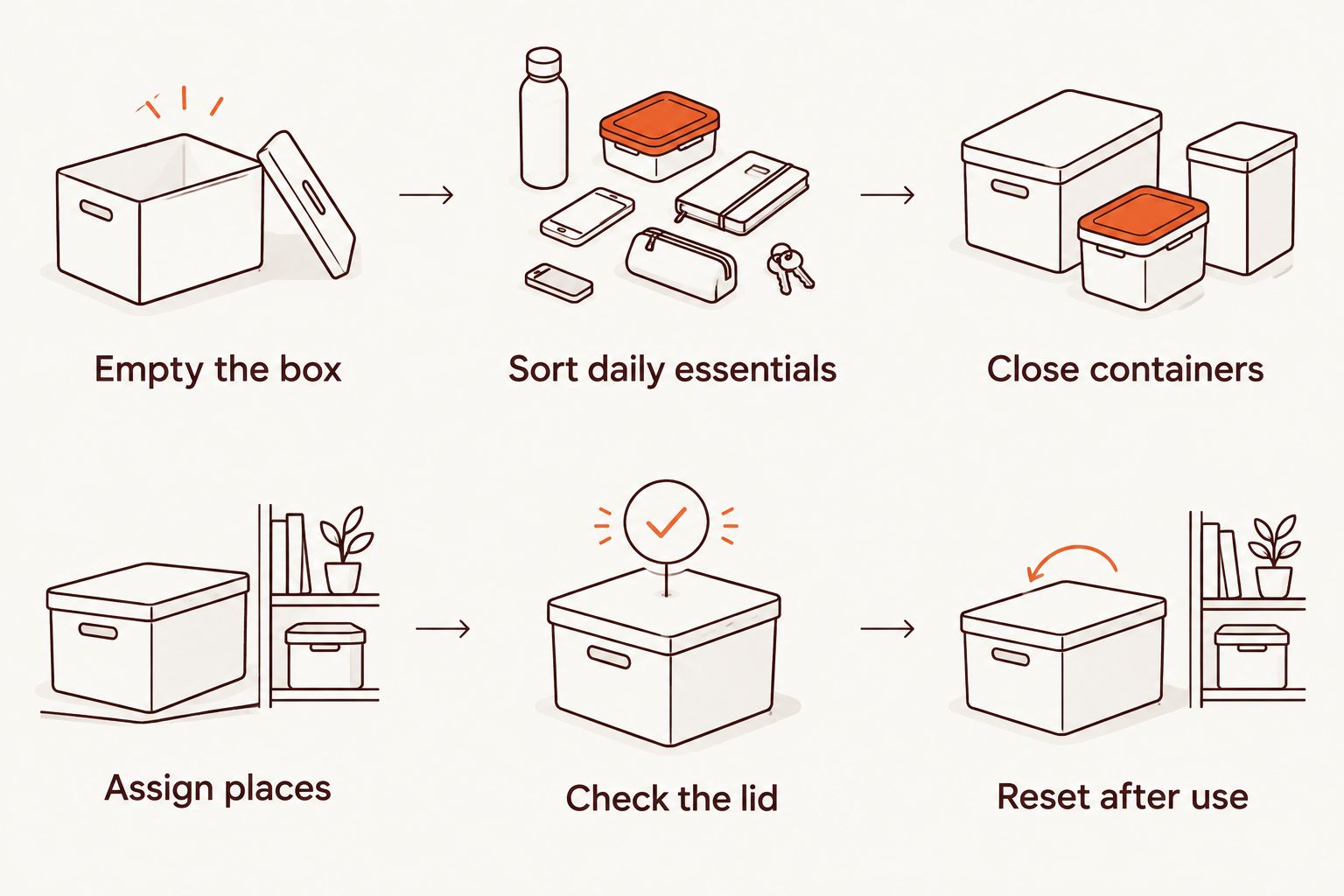
- Empty the box. Remove every accessory, container, paper packet, cable, and loose item. Work on a clear surface so small parts do not disappear beneath larger equipment.
- Sort daily essentials. Keep the tools you actually reach for in your normal routine. Move duplicate accessories, unopened refills, and occasional-use equipment into separate storage.
- Close containers. Keep loose supplies in suitable, closed containers rather than directly against the box lining. Retain original packaging and labels where they provide identification or storage instructions.
- Assign places. Give your main tool, supply container, and small accessories separate homes. Put the most-used items closest to the opening and support fragile pieces so they do not knock together.
- Check the lid. Close the box gently with everything in place. Nothing should press against glass, bend paper packets, trap a cable, or hold the closure partly open.
- Reset after use. Return only cooled, dry equipment. Remove residue and used cleaning materials before closing and securing the box.
For adult shoppers building a setup, Headshop carries smoking accessories alongside pipes, vaporizers, bongs, and dab rigs. Start with the equipment you already own; a storage purchase should solve a specific fit or organization problem.
Why this matters
A daily stash box should let you retrieve a tool without unloading the rest of your setup. If you must remove a container to reach papers, or pile accessories over a fragile piece, the arrangement needs changing.
Organization also separates tasks that do not belong together. Storage is not a charging station, a cooling rack, or a place to leave wet cleaning supplies. For your 2026 setup, make easy retrieval and safe storage separate requirements; neither substitutes for the other.
Give each part of your routine a home
Use locations that remain obvious after you close and reopen the box. Compartments help, but you can also arrange removable containers on a flat base without buying a fitted insert.
Daily tools: best for immediate access
Place your regular grinder, pipe, or other main accessory where you can lift it straight out. Keep the tool's complete footprint clear, including any handle, mouthpiece, or protruding part.
The advantage is direct access. The trade-off is that daily tools use the easiest-to-reach space, leaving less room for occasional accessories. Give that space to what you use, not to what looks best on display.
Closed supplies: best for keeping contents separate
Put suitable, closed supply containers beside the tools they support. Keep labels readable and avoid transferring contents into an unidentified container simply because it fits a divider.
Separate containers keep loose material away from papers and equipment. They also add bulk, so check the lid with the containers upright and fully closed. Do not assume a container fits because its base fits the compartment.
Small accessories: best for preventing loose parts
Group clean tips, caps, and similar small accessories in a removable compartment or suitable container. Keep parts for the same device together rather than mixing everything into a shared pocket.
This makes retrieval straightforward, but an overfilled small-parts container becomes another cluttered box. Keep only the accessories relevant to the equipment in your daily setup.
Backups: best kept outside the daily box
Store unopened refills, spare packaging, and occasional-use equipment separately. You should not need to dig through reserve supplies to reach your main tool.
The benefit is a simpler daily layout. The drawback is that you must remember where the backup storage lives. Give that storage a fixed location too, and keep all supplies secured against access by children and pets.
Match the box to the job, not the other way around
A storage box and a working surface solve different problems. Before replacing your current box in 2026, decide whether you need easier organization, a tray, a different footprint, or verified security features.
These products illustrate the difference between a storage-focused layout and a box that includes a rolling tray. The dimensions below describe listed product sizes, not confirmed interior clearance.
| Product | Best for | Stated features | Limitation to check |
|---|---|---|---|
| RAW Munchies Metal Storage Box 10.75x6.75" | Organizing essentials with a tray included | Metal storage box measuring 10.75 inches by 6.75 inches; includes a tin rolling tray | Interior depth, lock features, and odor protection are not established by the listed dimensions |
| Pulsar Sifter Box w/ Rolling Tray | A setup that specifically needs a sifter box and rolling tray | Sifter box with rolling tray; listed size is 4 inches by 5.75 inches | Verify usable interior space and whether the sifting function belongs in your routine |
Choose a box for the equipment it must hold, not for the number of accessories you can squeeze inside. The RAW Munchies Metal Storage Box suits a storage-and-tray requirement; the Pulsar Sifter Box w/ Rolling Tray suits a routine that actually calls for sifting. Neither product's name establishes child resistance or an airtight seal.
Headshop smoking accessories are best for adult shoppers organizing equipment for their own daily setup.


Why your stash box layout varies
Your equipment determines the arrangement. Use these factors to decide what belongs inside and what needs another location:
- Tool dimensions: Measure the equipment you intend to store, including protruding parts. Compare that with usable interior space, not just the box's outside measurements.
- Access order: Place regularly used tools where you can retrieve them directly. Put occasional accessories elsewhere rather than underneath everything.
- Fragile parts: Separate glass from hard tools and other glass pieces. Avoid stacking weight over delicate components.
- Power needs: Give battery-powered equipment an off-box charging location. Follow the device manufacturer's charging and storage instructions.
- Cleaning needs: Keep liquids, wet brushes, and used swabs out of the clean storage area. Return equipment only after cleaning and drying it as directed.
- Access control: Select storage with appropriate, verified security features when unauthorized access is a concern. A closed lid is not the same as a secured container.
Do not add an accessory just to occupy an empty compartment. Empty space gives your hand room to lift equipment and lets you see whether something is missing.
Keep heat, liquids, and charging outside the box
Store equipment only after it has cooled and dried. Do not place hot tools against paper packets, lining, or other stored items, and do not close a box around equipment that is still cooling.
Charge battery-powered devices outside the closed stash box, following their instructions. Keep loose metal objects away from exposed battery terminals, and stop using equipment with damaged batteries or charging components.
Keep cleaning liquids in their original, labeled containers and store them according to their labels. A stash box is not a reason to decant a cleaner into a smaller, unidentified bottle.
Use a separate location for used accessories awaiting cleaning. Putting a dirty item in an empty compartment does not make it ready for storage; it simply turns that compartment into another surface you must clean.
Build a reset you can repeat
After each use, return everything to its assigned location rather than dropping it into the nearest gap. Close supply containers first, then put away cooled, dry tools and check that small accessories are accounted for.
Remove loose residue using a method appropriate for the box material. Follow the manufacturer's care instructions rather than soaking wood, fabric, or fitted inserts in a cleaner intended for another surface.
Review the layout whenever you change your main equipment. A new device or taller container changes the fit even when the box itself stays the same. Treat your 2026 arrangement as a working layout, not a permanent collection display.
Before closing, check:
- Containers are closed and identifiable.
- Tools are cool, dry, and switched off where applicable.
- Fragile pieces are supported without pressure from other items.
- Used cleaning materials and loose waste have been removed.
- The lid closes freely and the security mechanism is engaged, if fitted.
What should you keep in a daily stash box?
Keep your current supply in suitable packaging, your regular tool, and the clean accessories required for that setup. Add papers, tips, or a small working tray only when they belong to your routine.
Leave bulk refills, duplicate tools, charging equipment, and cleaning liquids elsewhere. A daily box should hold a working setup, not every smoking accessory you own.
Does organizing a stash box stop odors?
Organizing a stash box does not make it odor-proof. Closed, appropriate containers and removing residue address different issues from the box's construction and closure.
Check the specific storage product's stated features before relying on odor protection. A tray, wooden lid, or tidy arrangement alone does not establish a seal.
Should you lock a stash box after every use?
Secure your stash box after every use when it contains items that children, pets, or unauthorized people must not access. Store keys and access codes separately from the box.
A lock does not automatically establish certified child resistance. Check the product's actual security features and store the box out of sight and reach rather than relying on the closure alone.
FAQ
What's the easiest way to organize a stash box for daily use?
Give each daily tool a fixed place, keep supplies in suitable closed containers, and remove backup equipment. Arrange the box so you can lift out your main tool without moving other items.
Should I put a grinder inside my stash box?
Put a grinder inside your stash box if it closes securely and fits without pressing against other equipment. Remove loose residue and keep the grinder separate from fragile parts.
Can I store a pipe in my stash box right after using it?
Store a pipe only after it has cooled and is ready for clean, dry storage. Keep used equipment that needs cleaning separate from papers, clean accessories, and closed supplies.
Is a rolling tray better than a stash box?
A rolling tray provides a working surface, while a stash box stores your equipment. Use a tray alongside storage when your routine needs both, and check that an included tray does not crowd the contents underneath.
How often should I reorganize my stash box?
Reorganize your stash box when your equipment changes or you repeatedly move items to reach what you need. Return tools to their assigned places after each use so clutter does not become the normal layout.
Can I charge my vaporizer inside a closed stash box?
Charge your vaporizer outside a closed stash box and follow the manufacturer's charging instructions. Put the device away only when it is no longer charging and is cool and dry.
Does a stash box need dividers?
A stash box does not need dividers if suitable closed containers and a stable arrangement keep items separate. Add removable organizers only when they improve access without pressing on equipment or blocking the lid.
One last thing
Test your layout by taking out your main tool and putting it back without rearranging anything. If that simple movement fails, remove something before buying a larger box or another insert.
Keep that test when adding Headshop smoking accessories to your setup in 2026. Every addition needs a clear home; otherwise, it belongs in separate storage.
Related guides