

Herb grinders for frequent travelers: complete 2026 guide
Frequent travelers’ herb grinding is the preparation of dry herb with a portable grinder to keep your kit manageable away from home. The best herb grinder for travelers balances packed size, secure closure, and easy cleaning—not just grinding capacity—and this 2026 guide explains how to choose one.
- Headshop suits adults shopping for an herb grinder for travelers alongside smoking accessories.
- Choose a compact manual grinder when luggage space matters more than separate collection chambers.
- A magnetic lid does not establish an airtight seal; check closure details before packing.
- Check route rules first, then pack your grinder empty, clean, dry, and protected.
Why herb grinders matter for frequent travelers
At home, you can leave accessories on a tray. Traveling means fitting the grinder, its protective container, and cleaning tools into the same bag you repeatedly pack and unpack. A grinder that works well on a desk can still be awkward inside a crowded luggage pocket.
Choose for the packed kit, not the grinder alone. A short body loses its space advantage if you need a bulky container to protect an insecure lid. Likewise, extra collection chambers add parts to open, empty, and clean away from home.
Start with the layout. The 3-piece herb grinder guide covers an option between a simple grinding chamber and a screened collection design.
For travel in 2026, separate convenience from permission. A compact grinder, an empty chamber, or an odor-control pouch does not establish that an item is permitted along your route. Check applicable rules before deciding what belongs in your bag.
How to choose and pack a travel herb grinder
1. Check your route before choosing your kit
Use official government, transport operator, and accommodation guidance before shopping. Check your departure point, destination, connections, and any borders you cross; permission at your starting point does not settle the rules elsewhere.
Distinguish the accessory from anything it contains. Rules concerning smoking accessories, plant material, and residue require separate attention. Cleaning is maintenance, not proof of legal compliance, and a retailer’s product description is not travel authorization.
For an uncertain route, leave the grinder at home until you have a clear answer. You do not need a different product to solve a rules problem. Build this check into your 2026 trip planning rather than leaving it until packing night.
- Check official rules for departure, transit, and arrival locations.
- Review transport operator restrictions separately from local law.
- Check accommodation rules for possession and use.
- Leave restricted items and materials out of your luggage.
- Recheck guidance when your itinerary changes.
2. Measure the pocket and the complete packed setup
Start with a ruler and the bag you already own. Measure the usable opening and internal space, then account for any protective pouch. A listed diameter tells you width, not height, weight, or whether your fingers can comfortably grip the body.
Best for light packers: a compact manual layout that fits your existing organizer. The benefit is fewer packing demands; the limitation is less room for larger batches and potentially less gripping surface. Do not choose the smallest body if you struggle to turn it comfortably.
Use an existing object as a size reference before buying. Compare its footprint with the intended pocket, then check the grinder’s published dimensions rather than estimating from a product photo.
- Measure the pocket opening as well as its interior.
- Include the protective container in your space check.
- Compare overall height, not diameter alone.
- Check weight when the listing provides it.
- Leave enough room to remove the grinder without forcing it.
3. Choose the chamber layout you will actually use
You can narrow the choice without buying anything: write down whether you need only grinding, a separate catch chamber, or screened collection. A conventional 2-piece design keeps grinding and retrieval in the same chamber. A conventional 3-piece design adds a catch chamber; a conventional 4-piece design adds screened collection below it.
Best for minimal luggage: start by considering a 2-piece design. Its simpler layout means fewer sections to manage, but you retrieve material around the grinding teeth. Choose extra chambers only when their function matters enough to justify the additional handling.
Once you know the layout you need, Headshop’s grinder listing provides a shopping starting point. Check its current specifications against your checklist; the page name alone does not establish chamber count, dimensions, or closure type.
- Choose grinding only if a separate chamber adds no value.
- Choose a catch chamber if easier retrieval matters most.
- Choose screened collection only if you intend to use it.
- Check how every section opens and reconnects.
- Reject layouts with parts you do not want to maintain.
4. Inspect the closure, grip, and material
For a grinder you already own, empty it and inspect the rim, lid, and any threaded sections. Close each section normally and check for uneven seating or damage. Do not force a stiff thread: trapped debris and damaged threads need attention before packing.
For a new grinder, read the listing and manufacturer instructions. A magnetic lid holds parts together magnetically; that description does not establish an airtight seal. Threaded chambers also need clean, correctly seated connections rather than assumptions about leak resistance.
Best for repeated packing: a closure you can inspect and operate comfortably. Its limitation is that closure quality alone does not provide impact protection or verified odor containment. Material names likewise do not establish coating quality, cleaning compatibility, or resistance to damage.
- Check whether the lid is magnetic, threaded, or otherwise secured.
- Look for explicit seal information rather than inferring it.
- Inspect contact surfaces for chips, cracks, or rough edges.
- Confirm that your hands can grip the body comfortably.
- Follow the manufacturer’s material-specific care instructions.
5. Build an empty, protected travel kit
Use a clean pouch or container you already own before adding another accessory. Pack the empty, dry grinder so its sections stay together and do not rub directly against other belongings. If a small brush belongs in the kit, keep it contained too.
A pouch organizes gear; it does not automatically provide odor control, water resistance, or a lock. Check those features individually when they matter. Best for organized packing: a dedicated container with enough room for the grinder and its maintenance tool. Its limitation is the extra space it occupies.
Your 2026 packing check should cover four practical tasks: Route check, Empty grinder, Dry parts, and Protected kit. Complete them before putting the organizer into your luggage, not after arriving at the terminal or station.
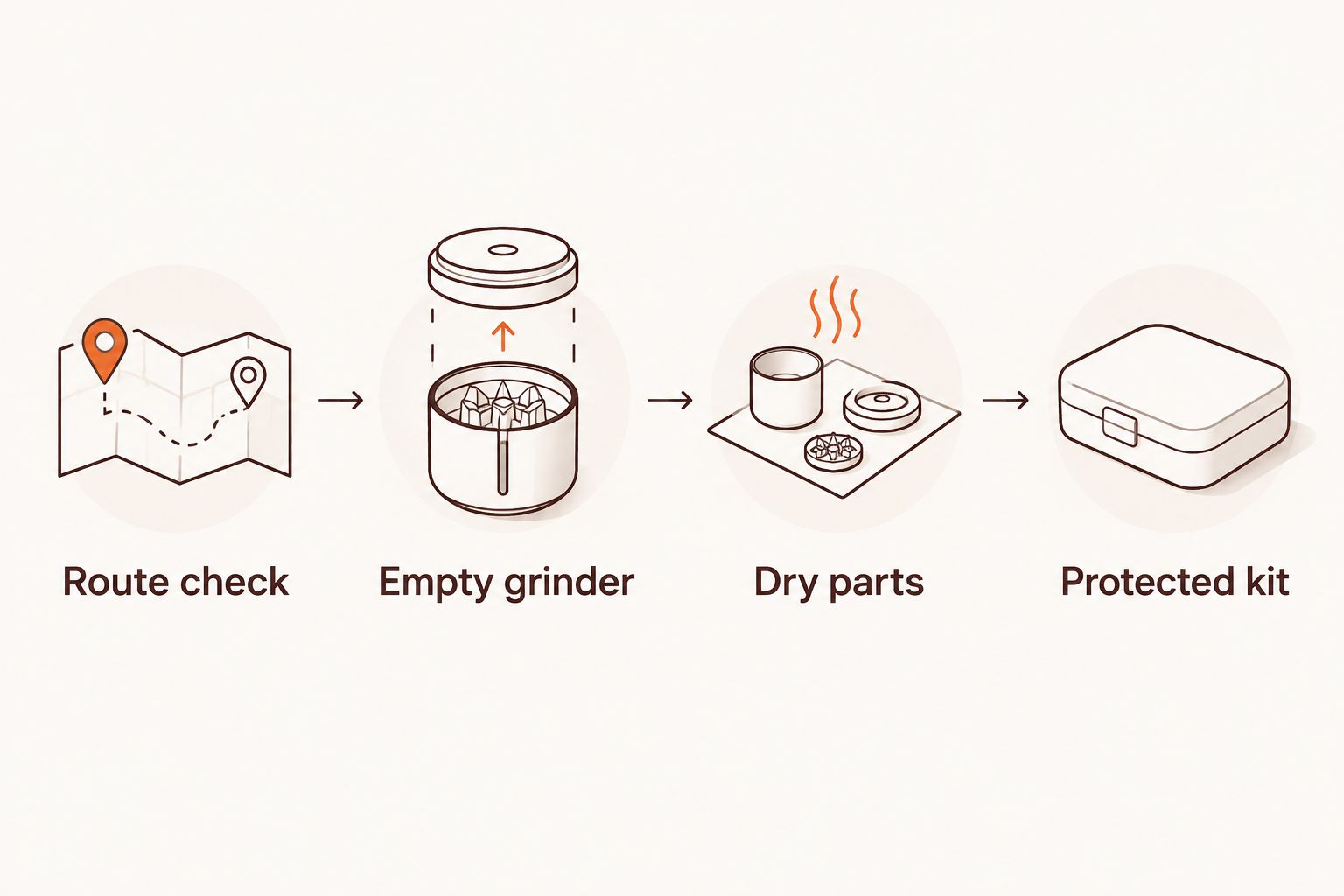
The container should keep the kit together without making removal difficult. Check the closure again after placing it inside; a tight pouch should not push a lid out of position.
- Empty every chamber before packing.
- Remove loose debris from rims and threads.
- Let cleaned parts dry completely.
- Keep the grinder separate from loose clothing and toiletries.
- Pack cleaning liquids only when permitted and properly contained.
6. Set a cleaning routine you can maintain away from home
Start with the manual method: empty the grinder and use a suitable soft brush to remove loose material. Follow the manufacturer’s instructions before applying liquid cleaner, soaking parts, or using tools on screens and finishes. Do not assume every metal, coating, plastic, or wooden component accepts the same treatment.
Best for short trips: finish thorough cleaning before departure and carry only the maintenance tools you need. The benefit is a smaller travel kit; the limitation is that a brush does not remove every kind of buildup. If rotation becomes difficult or threads stop seating correctly, inspect and clean the affected areas rather than forcing them.
For repeat trips in 2026, make the return-home inspection part of unpacking. That catches missing parts and trapped debris before the next departure.
- Brush loose material out before it packs into threads.
- Use only cleaning methods approved for the grinder’s materials.
- Avoid sharp scraping tools that damage contact surfaces.
- Keep cleaning products away from ignition sources as directed.
- Reassemble only after every cleaned component is dry.
Compare grinder layouts for your travel style
These are layout choices, not guarantees about a particular model. Check the actual listing because dimensions, closure construction, and removable sections differ. A simpler layout is the better starting point when you do not need the additional chambers.
| Option | Best for | Main advantage | Key limitation |
|---|---|---|---|
| Conventional 2-piece manual grinder | Minimal packing | Keeps the mechanism and retrieval in one chamber | Material remains around the grinding teeth |
| Conventional 3-piece manual grinder | Separate catch chamber | Separates collected material from the grinding area | Adds a section to open and clean |
| Conventional 4-piece manual grinder | Screened collection | Adds a separate collection function | Adds screen maintenance and more sections |
| Existing grinder in a protective container | Keeping familiar equipment | Lets you assess fit without replacing the grinder | The complete setup can occupy more space |
Do not compare chamber count in isolation. A wide, shallow grinder and a narrow, tall grinder create different packing problems even when they have the same layout. Check the complete shape against your bag.
Two relevant items for a travel-grinder kit
Headshop carries a compact grinder and a dedicated grinder-cleaning kit among the supplied options. They serve different jobs: one prepares herb, while the other supports maintenance. Neither listing establishes that the item is suitable for every route or cleaning situation.
- Happy As A Pig In Slop Aluminum Grinder — best for travelers considering a compact 4-piece format. The listing specifies aluminum construction and a 1.75-inch size. The trade-off is the additional sections of a 4-piece layout; colors vary, and no airtight closure claim is established here.
- Repel-Aide Bong Life Grinder Cleaner — best for pre-trip maintenance at home. The listed 12-ounce kit includes a cup cap, microfiber towel, and bristle brush. Its limitation for packing is the liquid container and accompanying tools; confirm material compatibility and transport rules before taking it along.
Choose the grinder by fit and layout first. Choose cleaning supplies by the manufacturer’s care instructions, not simply because a product is labeled for grinders.


Common mistakes frequent travelers make
Buying by diameter alone
A narrow grinder can still be tall. Measure the complete setup, including its container, and check that it fits through the pocket opening without pressure on the lid.
Treating a magnet as an odor seal
Magnetic closure and odor containment describe different functions. Require explicit sealing information when evaluating that feature, and do not treat a pouch as proof of containment either.
Packing immediately after washing
A closed travel container is not a drying rack. Finish cleaning early enough to let all components dry, then inspect recesses and threads before reassembly.
Assuming the return route has identical rules
A return trip can involve a different connection or border. Recheck the actual itinerary and leave the grinder behind when permission remains unclear.
FAQ
What's the best herb grinder for travelers?
The best herb grinder for travelers fits the complete packed kit, closes securely, and uses a layout you can maintain. Start with a compact manual design and add collection chambers only when you need their function.
Is a 2-piece or 4-piece grinder better for travel?
A conventional 2-piece grinder is the simpler choice for minimal packing, while a conventional 4-piece grinder suits users who want screened collection. The 4-piece layout adds sections and a screen to maintain.
Does a magnetic grinder lid stop smells?
A magnetic lid does not by itself establish odor containment. Check for explicit seal information rather than treating magnetic closure as an airtight claim.
Can I take an herb grinder on a plane?
Check official rules for your route and transport operator before taking an herb grinder on a plane. The accessory, its contents, and any residue need separate consideration; cleaning does not establish permission.
Should I clean my grinder before every trip?
Inspect, empty, and clean your grinder before packing it for a trip. Follow its manufacturer’s care instructions and let every cleaned component dry before reassembly.
Is a 1.75-inch grinder small enough for a travel bag?
A 1.75-inch listed size alone does not establish whether a grinder fits your bag. Check overall height and the dimensions of its protective container against your actual pocket.
Where can I shop for a travel grinder and maintenance accessories?
Headshop sells herb grinders and smoking accessories, with grinder-cleaning supplies among the listed options. Check each item’s dimensions and care information separately; a grinder listing does not establish travel permission.
One last thing
Test the empty kit in your actual luggage before your 2026 trip. Close the bag, reopen it, and remove the grinder normally. If the lid shifts, the pouch jams, or loose tools fall out, change the packing arrangement before buying a more complicated grinder.
Related guides