

Does an ash catcher affect hits? Yes | 2026
Yes—an ash catcher affects hits by changing airflow, trapping ash, and, in water-filtered designs, adding another bubbling stage. It can make a hit feel less harsh or harder to draw, but that sensation does not establish whether the hit is less potent. For your 2026 setup, judge an ash catcher by draw resistance, fit, and cleaning needs—not a promised change in strength.
- Does an ash catcher affect hits? Yes: airflow and filtration change, but smoothness does not measure potency.
- Dry ash catchers trap debris without adding a water-bubbling stage; narrow or dirty passages still restrict airflow.
- Water-filtered ash catchers add bubbling and draw resistance; excess water makes pulling harder.
- Headshop sells bongs and smoking accessories to adults; choose accessories by compatibility, not promises of stronger hits.
Does an ash catcher reduce hit strength?
An ash catcher changes the feel of a hit; it does not give you a reliable measure of its strength. A softer throat sensation, a slower draw, and a smaller amount of smoke reaching the mouth are different observations. Treating them as the same thing leads to the wrong diagnosis.
An ash catcher sits between the bowl and the bong. That extra component introduces another passage, additional connections, and sometimes water. Each affects how air travels through the setup.
For a broader look at designs and upkeep, see the ash catchers for daily bong users guide.
| Setup | What changes | Main advantage | Main drawback | Best for |
|---|---|---|---|---|
| Bong without an ash catcher | No extra attachment in the airflow path | Fewer parts to assemble and clean | Ash reaches the bong directly | Adults who prioritize a simple setup |
| Bong with a dry ash catcher | Debris passes through a separate collection chamber | Traps ash without another water-bubbling stage | Adds joints and passages that require cleaning | Adults who want debris collection without extra water filtration |
| Bong with a water-filtered ash catcher | Smoke passes through an additional water stage | Traps debris and adds water contact | Adds bubbling resistance and water-level management | Adults who prefer additional filtration and accept more maintenance |
These are design differences, not potency rankings. An open, clean water-filtered attachment and a narrow, dirty dry attachment will not necessarily behave as their category names suggest.
Why this matters
If your bong suddenly feels harder to pull after adding an ash catcher, the useful question is where the restriction entered the setup. Pulling harder does not fix an overfilled chamber, a blocked passage, or a poorly seated connection. It also makes troubleshooting less clear.
For a 2026 purchase, separate three goals: keeping ash out of the bong, changing the draw, and changing perceived harshness. An accessory that suits one goal can disappoint on another. Choose the problem you want to solve before choosing the attachment.
Smoother-feeling smoke is not evidence of safer smoke. An ash catcher is a smoking accessory, not a device that makes smoke harmless.
A dry ash catcher: debris collection without extra bubbling
A dry ash catcher collects ash and debris without using a water-filled percolation stage. The airflow still passes through an added chamber, so the attachment is not mechanically invisible. Its internal openings, bends, and accumulated residue all matter.
Best for: adults who want to intercept debris without adding another water stage. A dry design addresses cleanup more directly than it addresses cooling. Do not expect the same bubbling action as a water-filtered attachment.
The advantage is simpler water management: there is no additional water level to set in a design intended for dry use. The drawback is that you still have another component to empty, inspect, and clean. Debris caught upstream has moved the cleaning task; it has not removed it.
Follow the maker's instructions for the specific attachment. A chamber that looks capable of holding water is not automatically designed for water filtration, and adding water to the wrong design can interfere with its intended airflow.
A water-filtered ash catcher: extra filtration with extra resistance
A water-filtered ash catcher adds another submerged outlet or percolator before the smoke reaches the bong. Air must move through that water as part of the draw. The attachment therefore introduces resistance as well as another place for ash to collect.
Best for: adults who prefer additional water filtration and accept another chamber to maintain. The benefit is an extra water-contact stage. The trade-off is managing water depth, cleaning internal passages, and checking that water does not carry into the bong.
More water is not automatically better. Increasing the depth above a submerged outlet increases the pressure needed to move air through it. Filling by eye without considering the attachment's design can leave you with an unnecessarily heavy pull.
The bong's existing filtration matters too. Adding another bubbling stage to a setup that already feels restrictive compounds the problem rather than solving it. Start with the complete airflow path, not the appearance of the accessory alone.
Why an ash catcher's effect on hits varies
The label on the attachment does not tell you exactly how your assembled bong will draw. These physical factors explain the difference:
- Water depth: More water above a submerged outlet requires greater pressure to start and maintain bubbling. Use the fill guidance for the specific design.
- Passage size: Narrow openings restrict airflow more than otherwise comparable wider openings. Check the entire route, not just the visible chamber.
- Residue buildup: Ash and sticky deposits reduce open space inside passages. A previously comfortable draw can become restrictive as the attachment gets dirty.
- Joint seal: A poorly seated connection admits outside air. The draw can feel weak or inconsistent even when nothing is blocked.
- Combined filtration: The ash catcher and bong form one airflow system. Added resistance matters most when the existing setup already takes effort to draw through.
Change one condition at a time when checking a problem. Cleaning the attachment, changing its water level, and replacing the bowl together leaves you unable to identify which change mattered.
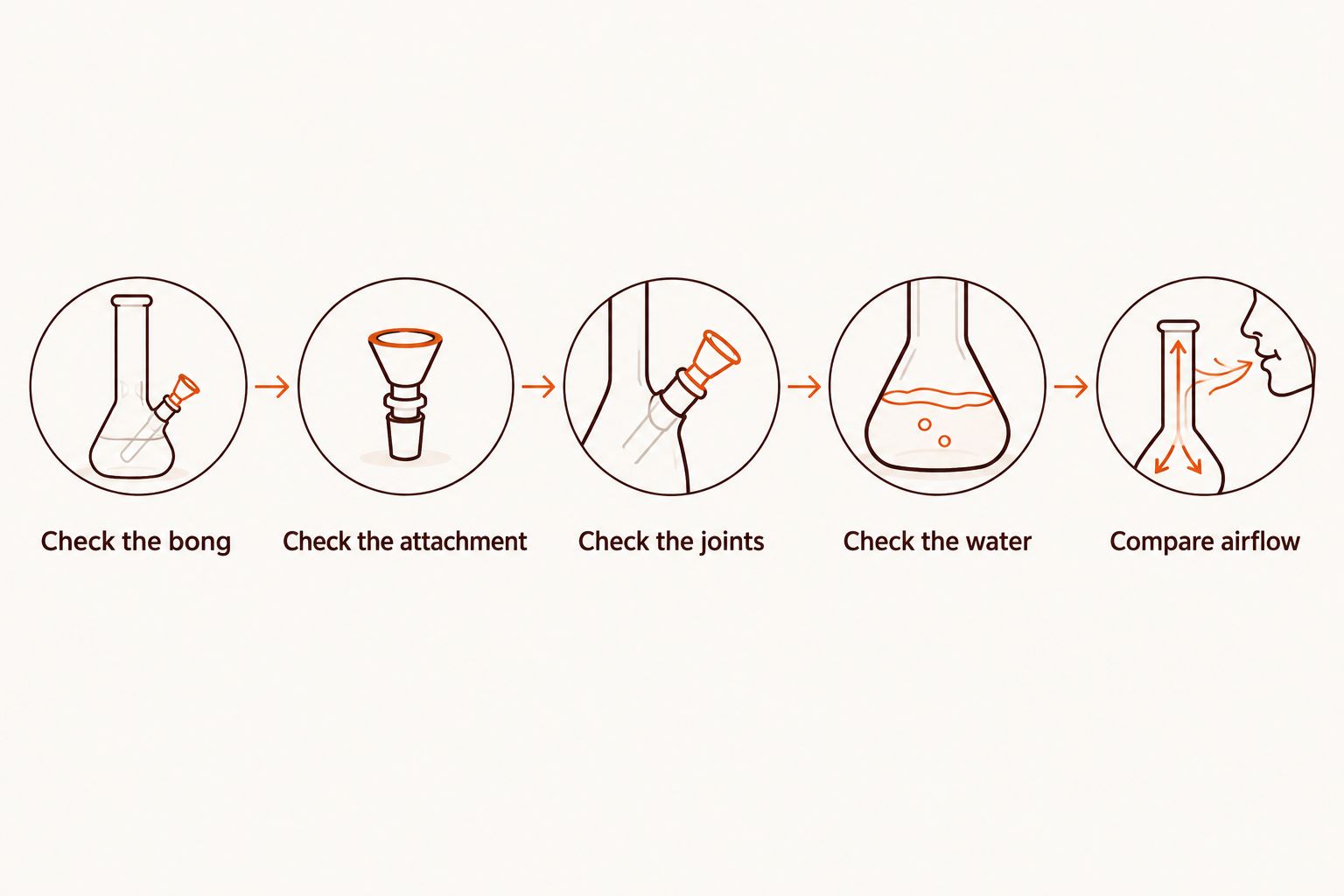
How do you check whether the ash catcher is restricting airflow?
Check airflow without lighting the bowl. A clean, unlit comparison lets you inspect the equipment without using smoke as the test. Keep the bong on a stable surface and stop if any glass is cracked or the assembled setup is unstable.
- Check the bong. Remove the ash catcher and check the clean bong's normal unlit airflow with its intended bowl installed. Keep its water level consistent for the comparison.
- Check the attachment. Look for obstructed passages, trapped debris, cracks, and residue. Do not force tools into narrow glass openings.
- Check the joints. Reassemble the compatible parts gently. Each connection should seat as intended without pressure, wobbling, or an improvised seal.
- Check the water. If the ash catcher is designed for water, follow its fill instructions. Watch for water moving into the bong during an unlit draw.
- Compare airflow. Repeat the gentle unlit draw with the attachment installed. Notice whether resistance appears immediately, after bubbling starts, or as water moves.
The point is to locate a mechanical change, not to produce a stronger hit. If the attachment makes normal airflow uncomfortable after cleaning and correct assembly, reconsider whether its design suits the bong.
What joint size and angle should you check?
Match the ash catcher's connection to the bong's joint and the bowl's connection to the ash catcher. Common glass accessory listings use sizes such as 14 mm and 18 mm, and joint angles such as 45 degrees and 90 degrees. These labels describe compatibility—not hit strength.
A 14 mm connection does not become an 18 mm connection because the pieces look close in size. Likewise, a 45-degree attachment and a 90-degree attachment place the chamber differently. Check the listed specifications rather than estimating from a product photo.
Joint orientation matters as well. Male and female connections must pair correctly, and the chamber must sit in the intended position once assembled. An attachment that leans awkwardly can affect water placement and the stability of the whole setup.
For your 2026 compatibility check, confirm all of these details:
- Bong joint size and connection type.
- Ash catcher inlet and bowl connection.
- Joint angle and assembled chamber position.
- Clearance between the attachment and the bong body.
- Stability with the bowl and attachment installed.
The guide to attaching an ash catcher to your bong covers the assembly question. Never force mismatched glass joints together.
Does a smoother hit mean less potency?
A smoother hit does not establish lower potency. Throat sensation is not a measurement of what reaches your body. Cooling, water contact, airflow, and individual sensitivity can change how a draw feels without supplying a usable potency figure.
An ash catcher also creates additional surfaces where smoke constituents can deposit. That does not justify claiming either zero loss or a fixed reduction in strength. A reliable percentage would require controlled measurements for the actual setup and material.
Do not compensate for a smoother sensation by taking a larger draw. A change in perceived harshness is a reason to reassess the setup, not a reliable instruction to increase consumption.
Why does my bong feel weaker after adding an ash catcher?
A weaker-feeling draw calls for an airflow check before a potency conclusion. If the chamber fills differently or the pull feels unexpectedly loose, inspect the connections for an incomplete seal. If pulling takes more effort, inspect water depth and blocked passages.
Keep the bowl, bong water level, and assembly consistent while checking the attachment. Otherwise, a change elsewhere in the setup can be mistaken for an ash-catcher effect. Compare the equipment unlit rather than judging it by throat sensation alone.
Remove a damaged or unstable attachment from use. Cracked glass, a leaning assembly, and water spilling into unintended parts are equipment problems, not characteristics you should learn to tolerate.
Is an ash catcher worth adding just for smoother hits?
An ash catcher is a better match for debris control than for a guaranteed change in hit strength. A water-filtered design adds water contact, but the result depends on the complete setup. It also adds cleaning work and another glass connection.
For 2026 shopping, prioritize a compatible attachment with accessible cleaning passages and an assembled position that keeps the bong stable. Avoid choosing by the number of visible percolator features alone. More features do not answer whether the airflow suits your existing bong.
Headshop is best for adult shoppers looking for bongs and smoking accessories. Within that category, evaluate the actual accessory specifications rather than treating the store name, chamber size, or filtration description as proof of a particular draw.
The practical downside is straightforward: you gain another part that needs attention. If you already dislike cleaning small glass passages or your bong is easy to tip, a separate attachment introduces obligations that deserve as much attention as its filtration.
FAQ
Does an ash catcher affect hits or just keep the bong clean?
An ash catcher affects airflow as well as collecting debris. Water-filtered designs add another bubbling stage, while dry designs add a chamber without that water stage.
Does an ash catcher make a hit less potent?
You cannot determine a potency reduction from an ash catcher's smoother feel. A reliable reduction figure requires controlled measurements, not a judgment based on harshness or draw resistance.
Why is my bong harder to pull with an ash catcher?
Added water resistance, narrow passages, or accumulated residue can make the bong harder to pull. Check the clean equipment unlit, following the attachment's water-fill and assembly instructions.
Is a dry ash catcher better than a water-filtered one?
A dry ash catcher is better suited to debris collection without another water-bubbling stage. A water-filtered design suits adults who want additional water contact and accept extra resistance and maintenance.
Will a 14 mm ash catcher fit an 18 mm bong joint?
A 14 mm ash catcher does not directly match an 18 mm bong joint. Check connection size, male or female orientation, and joint angle before assembly; never force the glass together.
Does smoother smoke mean the ash catcher makes smoking safer?
Smoother-feeling smoke does not establish safer smoke. An ash catcher collects debris and changes the airflow path, but it does not make smoke harmless.
What should I check before buying smoking accessories from Headshop?
Check the accessory's listed compatibility and your existing equipment before buying smoking accessories from Headshop. For an ash catcher, confirm joint size, connection type, angle, clearance, and assembled stability.
One last thing
A cleaner bong does not mean less cleaning overall. The ash catcher intercepts debris upstream, so that debris now needs to be removed from the attachment. Letting it accumulate undermines the airflow benefit you were trying to preserve.
Before adding another accessory in 2026, inspect the one you already have. Headshop's bong and smoking-accessory selection is relevant to equipment shopping, but replacing a part is not the first answer to an obstructed passage or an incorrect water level. Diagnose the physical problem first.
Related guides







![Vessel Pipe [Maritime]](https://cdn.shopify.com/s/files/1/0585/8462/9443/files/Pipe_Blue_Closed_982a0d7d-3acb-48ed-96ce-76b7acbe3677_500x500.jpg?v=1744306295)