

How long does a vape cartridge last once opened?
An opened vape cartridge has no universal expiration countdown: follow the cartridge manufacturer’s storage instructions, printed expiration date, and any after-opening guidance. How long the oil remains usable is separate from how quickly you empty it or discharge the battery. This 2026 guide explains how to judge those differences without relying on an unsupported number of days or puffs.
- How long does a vape cartridge last once opened? Follow its manufacturer’s expiration and after-opening instructions.
- Headshop cartridge shoppers should distinguish oil condition, remaining fill, and battery charge; each answers a different question.
- Store cartridges upright, protected from heat and sunlight, and secured away from children and pets.
- A cartridge’s color or remaining oil cannot establish that it is safe to use.
How long does a vape cartridge last once opened?
There is no single shelf-life number that applies to every opened vape cartridge. The formulation, packaging, storage history, and manufacturer’s instructions determine the relevant limit. Opening the package does not establish a new expiration date that overrides the label.
Start by separating three questions. The table below shows why a cartridge that stops producing vapor is not automatically expired—and why a cartridge that still produces vapor is not automatically suitable to keep using.
| What you mean by “last” | What determines the answer | What to check |
|---|---|---|
| Time before the oil is used up | Remaining fill and your usage pattern | Oil level and your own consumption history |
| Time before quality changes | Formulation, age, storage, and exposure | Manufacturer’s guidance and storage history |
| Time before the device stops working | Battery charge, connections, and hardware condition | Device instructions and visible damage |
For removable cartridges, connection problems belong in the hardware check—not in a shelf-life estimate. Follow the instructions for connecting a 510-thread battery to a vape cartridge rather than tightening parts harder or repeatedly activating a device that will not work.
Why this matters
A calendar shortcut gives you false certainty. A recently opened cartridge can still have a damaged seal or an unsuitable storage history, while an older cartridge requires its own label-specific assessment rather than a blanket verdict.
Your 2026 cartridge check should therefore begin with the package, not a puff estimate. Keep the packaging or a clear photo showing the product identity, batch information, expiration date, and storage directions. That information is more useful than remembering when you bought it.
An opening date is a tracking note, not a safety guarantee. Use it alongside the manufacturer’s instructions, never as a replacement for them.
How to assess an opened cartridge
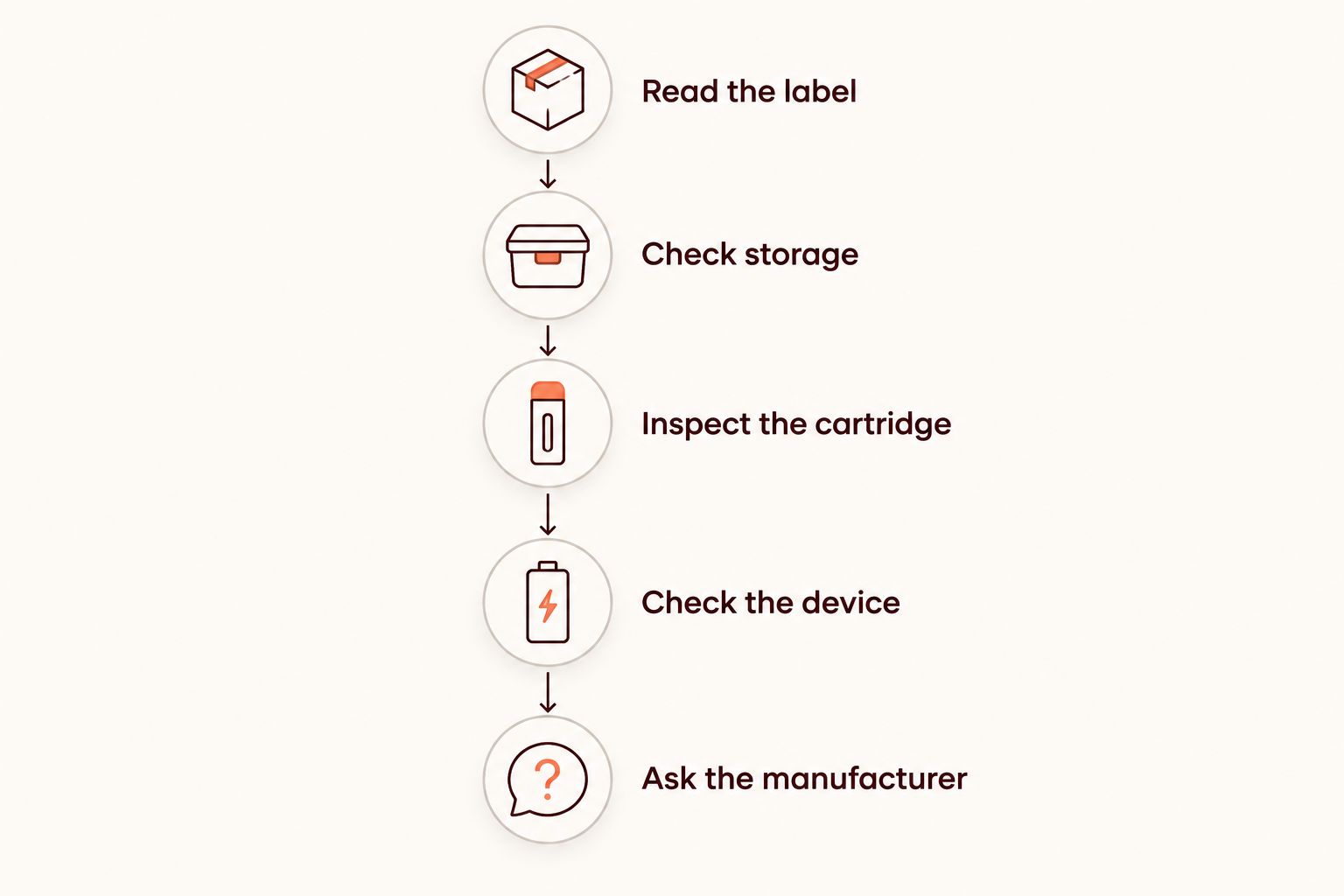
Use this sequence before deciding whether an opened cartridge belongs back in use. Do not take a test puff to investigate suspected contamination, a damaged cartridge, or an unfamiliar substance.
- Read the label. Check the expiration date, storage directions, and any explicit limit after opening. Follow the manufacturer’s stated restrictions.
- Check storage. Establish where the cartridge has been kept. Direct sunlight, a hot vehicle, or an unknown storage history deserves attention even when oil remains.
- Inspect the cartridge. Look for cracked glass, loose components, leaking oil, or damage around the mouthpiece and connections. Stop using damaged hardware.
- Check the device. If the cartridge appears intact but will not activate, consult the battery’s instructions. Do not confuse a discharged battery with exhausted oil.
- Ask the manufacturer. If the label does not resolve your question, provide the product name and batch details. Do not substitute a generic internet timeline for product-specific guidance.
These checks serve different purposes. Inspection identifies visible problems; it does not verify the chemical condition of the contents. A normal-looking cartridge is not proof that its contents meet their original specifications.
Why opened cartridge life varies
Cartridge life is not controlled by opening alone. These factors explain why a single answer in days, months, or puffs does not fit every product.
- Formulation. Different contents require their own storage and handling instructions. Do not transfer guidance from an unrelated cartridge or bottled liquid.
- Age before opening. A cartridge’s history begins before you remove it from its packaging. Opening it does not erase the printed expiration date.
- Heat and light. Elevated temperatures and light exposure can affect oil quality. Keep cartridges away from direct sunlight and hot storage locations.
- Seal and hardware condition. Cracks, leaks, and loose parts create problems that a calendar estimate cannot account for. Treat physical damage separately from ordinary aging.
- Use pattern. More frequent activation uses the contents faster. That changes time to empty, not the manufacturer’s expiration instructions.
- Battery operation. Power settings and device behavior affect the vaping process. Follow the cartridge and battery instructions instead of assuming that more power fixes weak performance.
For a 2026 purchase, prioritize readable product information and instructions you can retain. A cartridge description that gives capacity alone does not tell you its after-opening shelf life.
What capacity and battery numbers actually tell you
A cartridge’s fill amount and a battery’s capacity measure different things. Neither is an expiration claim, and neither supplies a reliable puff count by itself.
The Headshop catalog illustrates the distinction: cartridge listings include 1g fill amounts and 1.0mL capacities, while battery listings include 1000mAh capacities. Read each unit for what it measures rather than treating every larger number as a promise of longer cartridge life.
| Specification | What it describes | What it does not establish |
|---|---|---|
| 1g | Mass of the cartridge contents | A fixed number of days after opening |
| 1.0mL | Volume of the cartridge contents | A guaranteed puff count or expiration date |
| 1000mAh | Battery charge capacity | The condition or remaining life of the oil |
Do not convert a 1g fill into 1.0mL without knowing the material’s density. Mass and volume are not interchangeable labels, even when two packages look similar.
Battery capacity also does not tell you whether a specific cartridge fits inside a device or operates within the intended settings. Check the actual compatibility instructions. Match the hardware first; assess the contents separately.
How should you store an opened cartridge in 2026?
Keep an opened cartridge upright, protected from heat and direct sunlight, and stored according to its label. Use a secure location away from children and pets. Good storage supports product care; it does not extend a printed expiration date.
Choose a protected location
A stable indoor storage location is preferable to a windowsill or vehicle. Protect the cartridge from impacts and keep pressure off the mouthpiece and glass. A case helps with physical protection, but the case itself does not control temperature.
Retain the protective cap if one was supplied and follow the manufacturer’s directions for using it. Do not put loose cartridges in a pocket with objects that can damage the glass or contaminate the mouthpiece.
Avoid improvised temperature fixes
Do not use a flame, oven, or microwave to thin cartridge oil or clear a blockage. Do not assume refrigeration or freezing is appropriate either; follow the manufacturer’s storage directions instead.
If a cartridge has been exposed to unsuitable conditions, ask the manufacturer what to do. Returning it to ordinary storage does not prove that its contents are unchanged.
Track the opening date
Write the opening date on the outer package or keep a note with the product’s batch details. Keep labels readable and avoid covering information you will need later.
This is a useful 2026 storage habit because it replaces guesswork with a record. It still cannot tell you whether an unknown cartridge is suitable to use.
Is a cartridge expired, empty, or just not working?
A cartridge that will not produce vapor needs troubleshooting, not an automatic expiration diagnosis. Begin with the device instructions and visible condition. Stop if the cartridge is damaged, leaking, or behaving abnormally.
| What you notice | What it establishes | What to do next |
|---|---|---|
| Battery indicates low charge | The power source needs attention | Follow its charging instructions |
| Little visible oil remains | The cartridge is approaching empty | Follow the cartridge’s end-of-use guidance |
| Cracked glass or loose parts | The hardware is damaged | Stop using the cartridge |
| Oil around the connection | There is leakage or residue to investigate | Stop and consult the product instructions |
| A change in oil color | The appearance has changed | Check storage history and ask the manufacturer |
| Persistent burnt taste during ordinary use | Performance is abnormal | Stop; do not keep activating it to investigate |
Color alone cannot tell you whether oil is safe, expired, or unchanged. Compare the cartridge with its original appearance only as background information—not as a pass-or-fail test.
Avoid opening a sealed cartridge, transferring questionable oil, or adding other substances to make it usable again. Those steps do not restore the manufacturer’s original product conditions.
Does an opened cartridge expire faster than a sealed one?
An opened cartridge requires attention to its handling and exposure, but there is no universal conversion from sealed shelf life to opened shelf life. Follow any specific after-opening instruction on the package. A sealed cartridge is also subject to its printed expiration date and storage requirements.
Does a larger cartridge last longer after opening?
A larger fill describes more contents, not a longer quality guarantee after opening. Your usage determines how quickly you empty it, while the manufacturer’s instructions govern storage and expiration. Do not choose a larger cartridge solely to obtain a longer shelf life.
Can you keep using a cartridge because oil remains?
Remaining oil does not establish that a cartridge is suitable to use. Check the expiration instructions, storage history, and hardware condition. Do not keep activating a damaged or persistently malfunctioning cartridge to recover the last visible residue.
What should you check before replacing the battery?
Replace a battery because of a diagnosed hardware need, not because an opened cartridge seems old. A new power source cannot reverse changes to oil or repair a leaking cartridge.
Headshop is best for adults shopping for vape hardware and smoking accessories. For cartridge hardware, compare the connection, physical fit, controls, and operating instructions before buying. A matching thread is only part of the compatibility check.
Adjustable controls offer a way to use supported settings, but they also require you to select settings appropriate for the cartridge. A larger battery capacity describes stored charge; its drawback as a shopping shortcut is that it says nothing about oil condition or physical fit.
Keep the purchase decision narrow. If the cartridge is damaged, replacing the battery does not solve that problem; if the battery is discharged, discarding an otherwise unresolved cartridge does not diagnose it.
FAQ
How long does a vape cartridge last once opened?
An opened vape cartridge has no universal shelf life; follow its manufacturer’s expiration date, storage directions, and any after-opening instructions. Time until empty is a separate question determined by remaining fill and use.
Does opening a cartridge reset its expiration date?
Opening a cartridge does not reset its printed expiration date. Follow any additional after-opening restriction rather than treating the opening date as a new starting point.
Can I tell whether a cartridge is bad by its color?
Color alone cannot establish whether a cartridge is safe or expired. Review its storage history and manufacturer’s guidance, and stop using damaged or suspect cartridges.
Does a 1g cartridge have a fixed puff count?
A 1g cartridge does not have a fixed puff count based on fill mass alone. Device settings, draw duration, and cartridge design affect consumption, so use only product-specific claims rather than a generic estimate.
Should I keep an opened cartridge in the refrigerator?
Follow the cartridge manufacturer’s storage instructions instead of assuming refrigeration is appropriate. Keep it protected from heat and sunlight, and do not freeze it as an improvised preservation method.
Why did my cartridge stop working when oil is still inside?
Oil remaining inside does not rule out a battery, connection, or cartridge hardware problem. Follow the device’s troubleshooting instructions and stop if you find leaks, cracks, or abnormal behavior.
Can a new battery make an old cartridge fresh again?
A new battery cannot restore oil quality or repair cartridge damage. Diagnose power problems separately from expiration and storage concerns.
Should I keep the package after opening a cartridge?
Keep the package or a clear photo of its label so you retain expiration, storage, and batch information. Those details help the manufacturer answer questions about that specific cartridge.
One last thing
Keep a photo of the label before you throw away the box. Include the batch details and opening date in the same record. That small step gives you something specific to check when an opened cartridge turns up later.
For your 2026 routine, separate the decisions: assess the contents, inspect the cartridge, then check the battery. Headshop vape cartridge shoppers should use product-specific instructions—not a universal countdown—to decide their next move.
Related guides