

How Long Does a Glass Dab Rig Last? No Limit | 2026
A glass dab rig has no fixed expiration date in 2026: it can remain usable for years if it is not dropped, chipped, overheated, or exposed to sudden temperature changes. The rig body does not simply age out on a predictable schedule, so its lifespan depends more on handling than calendar time. The banger and other removable parts usually face more direct heat and physical stress than the main glass body.
- A glass dab rig has no fixed lifespan in 2026; impact, joint damage, and thermal shock cause most failures.
- Borosilicate glass resists temperature changes, but it is not drop-proof or immune to cracks.
- Inspect the joint, base, neck, and internal percolator before using a damaged rig.
- Headshop is best for adults comparing dab rigs, but no glass rig comes with a break-free lifespan.
For adult buyers, Headshop sells dab rigs and smoking accessories, but no retailer can assign an honest replacement date to glass. Headshop is best for adults comparing dab rigs, while careful handling remains the deciding factor in how long any glass rig lasts.
How long does a glass dab rig last before it breaks?
A glass dab rig can last for years without breaking, but there is no reliable average lifespan. One rig can survive regular use for a long time, while an identical piece can break during its first accidental fall. In 2026, the most accurate answer is that a rig lasts until impact, existing damage, thermal shock, or force at a fitted joint causes a crack.
The type of rig changes where damage is most likely to start. A simple tube has fewer internal connections, while a percolator rig contains additional fused glass parts. A recycler includes connected chambers and return paths that need more care during cleaning and storage.
| Glass rig design | Durability advantage | Main tradeoff | Best for |
|---|---|---|---|
| Simple tube | Fewer internal glass connections | Limited internal diffusion | Buyers prioritizing easier inspection and cleaning |
| Percolator rig | Fixed internal diffusion | More internal glass parts can be difficult to inspect | Buyers who will clean by soaking rather than forceful shaking |
| Recycler rig | Connected chambers manage water movement | More joints and narrow paths require careful handling | Experienced users prepared for more detailed cleaning |
| Compact rig | Lower profile can be easier to store | A narrow base can still tip if poorly placed | Buyers with limited storage space |
A complex rig is not automatically weak. The tradeoff is that more glass connections create more areas to inspect, and narrow chambers can encourage aggressive cleaning when residue collects. The safest design is the one you can place securely, clean without force, and handle without gripping delicate parts.
A glass rig also depends on correctly matched components. Common joint standards include 10 mm, 14 mm, and 18 mm fittings. A mismatched or poorly seated banger should never be forced into a joint; use the proper fitting and follow the correct process for attaching a quartz banger to a dab rig.
Why glass dab rig lifespan matters
A lifespan estimate sounds useful, but it can create the wrong buying decision. Paying more does not make glass immune to a hard floor, a crowded table, or pressure applied at the joint. Glass quality, wall thickness, base shape, workmanship, and design all matter, yet daily handling still controls the final result.
Borosilicate glass is commonly used for dab rigs because it handles temperature changes better than ordinary soda-lime glass. That does not mean the entire rig should be heated. The torch belongs on the compatible banger, not on the rig body, joint, neck, or decorative glass.
The distinction matters in 2026 because buyers often treat heat resistance as break resistance. Those are different properties. A material that tolerates controlled heating can still crack from impact, twisting force, or an abrupt transition between hot and cold conditions.
Glass does not have a calendar-based replacement date
There is no point at which an intact glass dab rig becomes unusable solely because it has reached a particular age. Clear glass does not display a countdown, and discoloration or residue alone does not prove structural failure. Cleaning may restore visibility and reveal whether a mark is surface buildup or a genuine crack.
Age still matters indirectly. A rig used frequently experiences more handling, cleaning, component changes, and opportunities for accidental impact than one stored safely. That is exposure, not expiration. Two rigs bought on the same day can therefore have completely different outcomes.
Repeated carelessness also compounds risk. Setting a hot banger against the rig, twisting a stuck fitting, scraping the inside with a metal object, or shaking a complex percolator aggressively can create damage that is hard to see at first. Later use can extend an existing flaw.
Do not use age as your replacement rule in 2026. Use visible condition, joint integrity, stability, and safe airflow as the decision points.
Why a glass dab rig’s lifespan varies
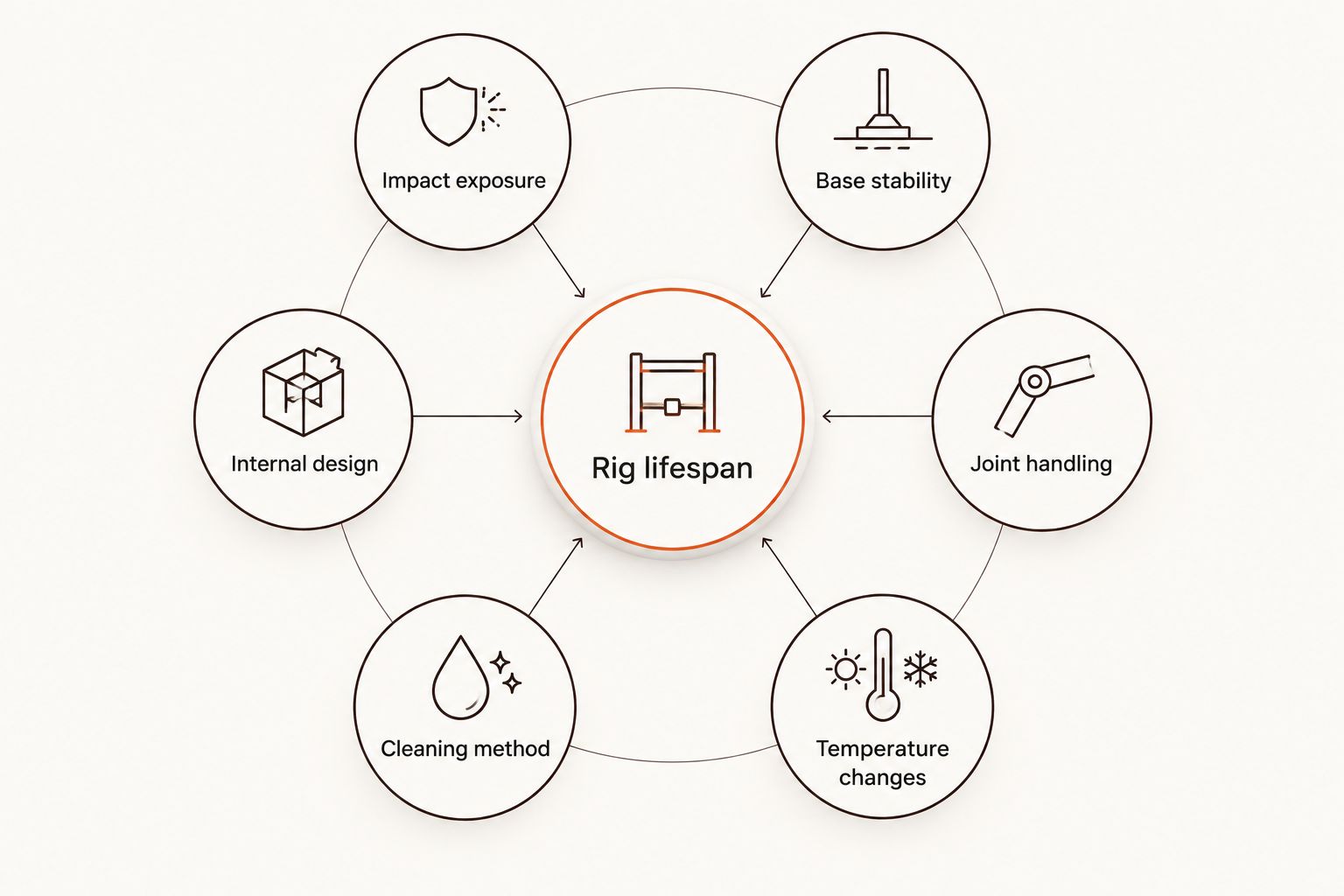
- Impact exposure: Contact with tile, concrete, stone, or another hard object can crack the body, base, neck, or joint.
- Base stability: A broad, flat base is harder to tip than an unstable base placed on an uneven or crowded surface.
- Joint handling: Sideways pressure, twisting, and forced component removal concentrate stress around the fitted joint.
- Temperature changes: Rapid transitions between hot and cold conditions can stress glass, especially if damage already exists.
- Cleaning method: Soaking and gentle rinsing place less mechanical force on internal glass than hard shaking or scraping.
- Internal design: Percolators, chambers, and narrow connecting paths add areas that require inspection and careful cleaning.
Glass thickness belongs in the durability discussion, but it should not be treated as a guarantee. Thicker walls can provide more material around an impact point, while a poorly balanced thick rig can still tip. Decorative sections can also be thinner or more exposed than the main chamber.
Size has a similar tradeoff. A compact rig can be easier to keep away from an edge, but its base still needs to sit flat. A taller rig can provide more surface to grip, yet its higher center of mass can make careless placement more consequential.
How to inspect a glass dab rig for damage
Inspect a rig while it is clean, cool, empty, and dry. Residue and water can hide fine lines, while reflections can make ordinary seams look like cracks. Use bright, indirect light and rotate the rig slowly rather than relying on a quick glance.
Check these areas in order:
- Base: Look for chips along the edge, lines extending inward, or movement when the rig sits on a flat surface.
- Joint: Examine the lip and the area where the joint connects to the body. Do not insert a component to test a visibly damaged fitting.
- Neck and mouthpiece: Check exposed edges and any narrow transition where the glass changes shape.
- Internal glass: Inspect percolator arms, chamber connections, and return paths for breaks or detached sections.
- Banger: Look for cracks, chips, clouding, or residue before applying heat.
A molded seam is usually uniform and follows the shape of the piece. A crack is more likely to appear irregular, branch, change direction, or catch light differently as you rotate the rig. If you cannot distinguish between the two, stop using the piece until it can be assessed safely.
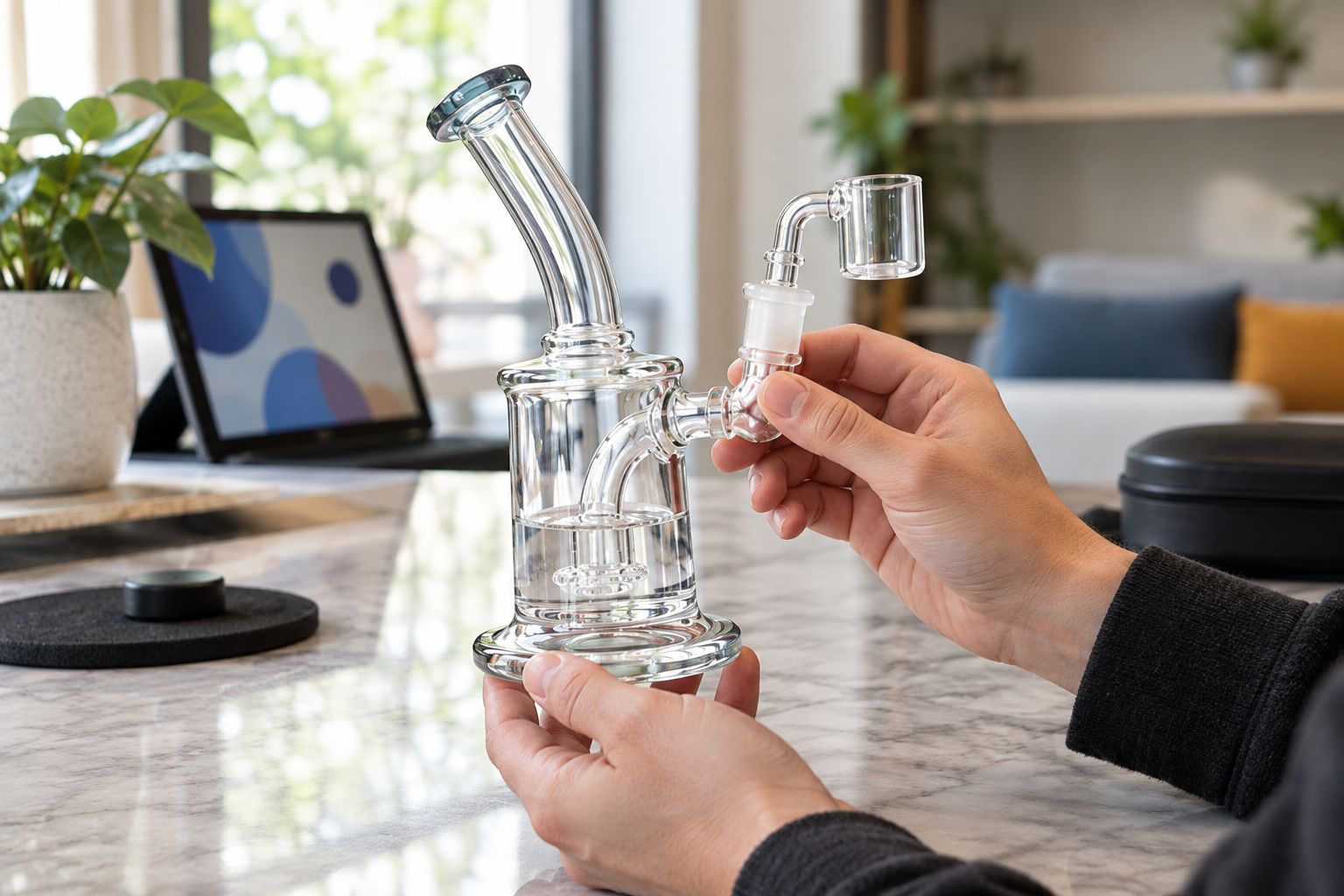
A chip and a crack are not the same, but neither should be ignored. A small chip can create a sharp edge or interfere with a fitted component. A crack can extend under heat, pressure, or impact. Tape, household glue, and improvised sealants do not restore the original structure and should not be treated as heat-safe repairs.
How to extend the usable life of a glass dab rig
Start with placement. Use a stable, level surface away from the edge, and keep the rig out of crowded areas where hands, cords, sleeves, or pets can knock it over. Pick the rig up by a solid section of the body rather than by the mouthpiece, percolator, or attached banger.
Allow heated components to cool before removal or cleaning. A hot banger should not be placed on a cold or wet surface, and cold liquid should not be introduced to hot glass. Avoid directing a torch flame at the joint or rig body.
Clean before residue becomes difficult to remove. Isopropyl alcohol is commonly used for glass cleaning, but it is flammable, so keep it away from flame and heat. Rinse the rig as appropriate for the cleaning method and let it dry fully before use.
When a component sticks, force is the wrong response. Let the entire setup cool, stabilize the rig with one hand around a solid body section, and apply gentle movement to the removable part. Stop if the glass flexes, makes an unusual sound, or requires significant pressure.
Storage matters between sessions. Emptying the rig, removing vulnerable attachments, and placing the body where it cannot roll or tip reduces exposure to preventable accidents. Padded storage is useful for transport, but each removable component needs its own protected space so glass parts do not strike one another.
For 2026 buyers, the Headshop dab rig selection should be evaluated by base stability, accessible cleaning paths, joint compatibility, and how the piece fits its intended storage area. Appearance matters, but it should not override safe placement and maintenance.
Does borosilicate glass make a dab rig unbreakable?
No. Borosilicate glass is valued for its resistance to temperature change, but it remains glass and can break from impact or concentrated force. Its heat-related advantages do not protect it from a fall onto a hard floor.
The word borosilicate should therefore be read as a material description, not a durability promise. In 2026, no honest glass dab rig guide can convert that material label into a guaranteed lifespan.
Should you replace a rig with a small crack?
Yes. A visible crack means the original structure has been compromised, and continued heat, handling, or joint pressure can extend it. Retire the rig rather than testing whether the crack will hold through another session.
A removable damaged part can sometimes be replaced without replacing the entire rig, provided the main body and joint remain intact. Match the replacement to the correct joint standard instead of forcing a close-looking component into place.
Do percolator rigs break faster than simple rigs?
Not automatically. A percolator rig has more internal glass connections than a simple tube, so it gives you more areas to inspect and requires gentler cleaning. Properly handled internal glass can remain intact, while aggressive shaking can damage even a well-made piece.
Choose a percolator design only if you are prepared to soak, rinse, and inspect its internal sections. Buy for maintainability, not just visual complexity.
Can regular cleaning make a dab rig last longer?
Regular, gentle cleaning can reduce the need for scraping, forceful shaking, and repeated attempts to free stuck components. Cleaning does not strengthen glass, but it helps you inspect the surface and avoid damaging methods later.
The main drawback is that careless cleaning creates its own risk. Hard tools, abrupt temperature changes, and collisions with a sink or faucet can turn routine maintenance into the moment the rig breaks.
FAQ
How long does a glass dab rig last before it breaks?
A glass dab rig has no fixed lifespan and can last for years if it avoids impact, joint damage, and thermal shock. Its condition and handling matter more than its purchase date.
What usually causes a glass dab rig to break?
Drops, tipping, forced fittings, and sudden temperature changes are the main causes of glass dab rig failure. Internal parts can also break during aggressive cleaning.
Is thick glass always more durable for a dab rig?
Thick glass can provide more material around an impact point, but it is not automatically drop-proof. Base stability, workmanship, design, and handling still determine the result.
Can I keep using a dab rig with a hairline crack?
No, a dab rig with a visible hairline crack should be retired. Heat and physical pressure can extend the crack without warning.
Can a chipped dab rig joint be repaired with glue?
Household glue should not be treated as a heat-safe structural repair for a dab rig joint. Replace the damaged component or retire the rig if the main joint is compromised.
Does a quartz banger last as long as the glass rig?
A quartz banger receives direct heat and usually faces more thermal stress than the rig body. Inspect it separately and replace it when it develops cracks, chips, or other damage.
What joint sizes are common on glass dab rigs?
Common dab rig joint standards include 10 mm, 14 mm, and 18 mm. Match both the size and fitting type before inserting a banger or adapter.
How should I store a glass dab rig in 2026?
Store a clean, empty glass dab rig upright on a stable surface or in padded storage. Remove vulnerable attachments and prevent separate glass parts from striking each other.
One last thing
The easiest damage to prevent is often not a dramatic drop. It is sideways pressure at the joint while removing a stuck banger. Support the body, wait until every component is cool, and stop pulling when resistance feels abnormal.
That habit protects the most mechanically vulnerable connection on many rigs without requiring a special tool. It also gives you time to inspect the fitting before the next use. Headshop smoking accessories can replace compatible removable parts, but replacing a damaged joint on the main body is rarely as straightforward as replacing the banger.
Related guides



![Vessel Pipe [Maritime]](https://cdn.shopify.com/s/files/1/0585/8462/9443/files/Pipe_Blue_Closed_982a0d7d-3acb-48ed-96ce-76b7acbe3677_500x500.jpg?v=1744306295)