

Do stash boxes really block smell? Seals matter | 2026
Yes, a stash box can reduce escaping smell when its closure creates an effective seal, but an ordinary storage box does not automatically block odor. A loose lid, dirty seal, or odor-bearing residue on the outside defeats that protection, and opening the container releases the air inside. Choose a sealed inner container for odor control and treat the outer stash box as an organizer unless its construction supports more.
- Do stash boxes really block smell? Sealed containers reduce escaping odor; loose-lidded organizers are not reliable odor barriers.
- Headshop's stash accessories include organizers and containers; a product name alone does not establish odor-blocking performance.
- A lock controls access, not airflow. Inspect the lid, gasket, and closure separately.
- Clean tools and a sealed inner jar address odor sources that an outer box alone does not.
Why this matters
A box that hides your accessories from view is not necessarily a box that contains their smell. Those are separate jobs. You need to distinguish organization, access control, and odor containment before choosing a storage setup.
The same distinction applies to lockable stash boxes: a lock does not establish an airtight seal. For a 2026 purchase, look past the decorative finish and inspect how the lid meets the body.
Does a stash box actually stop smell from escaping?
A stash box stops odor from escaping only to the extent that its walls and closure contain odor-bearing air. A lid that merely rests on top provides coverage, not a dependable seal. A gasket compressed by a suitable closure addresses the opening where air otherwise passes.
Activated carbon works differently: it adsorbs odor compounds onto its surface. That gives carbon-lined storage a separate odor-control mechanism, but carbon does not make a poorly closed bag airtight or provide unlimited adsorption capacity.
| Storage option | Best for | Useful feature | Limitation |
|---|---|---|---|
| Ordinary stash box | Organizing accessories at home | Keeps items together and out of sight | A loose lid leaves an airflow path |
| Gasket-sealed container | Containing odor at its source | A compressed gasket closes the lid gap | Dirt, damage, or poor seating compromises the seal |
| Carbon-lined bag | Adding odor adsorption around stored items | Activated carbon adsorbs odor compounds | Closure quality and carbon condition still matter |
| Sealed container inside a stash box | Separating odor control from organization | Inner container handles containment; outer box holds accessories | Adds another container to open and maintain |
This comparison concerns construction, not a measured performance ranking. Neither a material name nor a smell-proof label establishes how a particular container performs after repeated use. Check the actual closure and the manufacturer's instructions.
What does an airtight seal change?
An effective seal limits air exchange through the lid opening. That matters because airborne odor compounds escape through gaps even when the surrounding walls are solid.
Inspect the complete contact surface, not just the latch. A closure that presses down unevenly or leaves debris across the gasket does not create the same barrier as a clean, correctly seated lid.
What does activated carbon change?
Activated carbon adsorbs compounds rather than simply covering their smell with another fragrance. Its effectiveness depends on the compounds involved, the carbon, and how air contacts it.
Do not assume every carbon-lined accessory has the same construction or maintenance method. Follow the instructions for that specific item; heating, washing, or spraying a liner without approval risks damaging it.
Ordinary stash boxes: useful organization, limited odor protection
A conventional stash box gives you somewhere to keep papers, tools, and small accessories together. That is a valid reason to buy one. It does not require the box to be airtight.
For odor control, examine the lid rather than the exterior style. A lift-off lid with visible clearance is not equivalent to a gasketed closure, even when both products are called stash boxes.
Best for: adults who want an organized storage space and already keep odor-bearing contents in a separate sealed container. The benefit is convenient organization; the drawback is that the outer box adds no dependable odor barrier unless its closure is designed for that job.
A decorative box also needs a cleaning method suited to its material. Do not apply a glass-cleaning routine to painted wood, fabric, or resin without checking the care instructions.
Sealed jars and containers: containment at the source
A sealed inner container puts the odor barrier directly around the contents instead of around your entire accessory collection. You can then use a larger box for items that do not need the same seal.
Glass provides a nonporous container wall, but the lid remains critical. A glass jar with a loose cover is still a loosely covered jar. Clamp hardware, threads, and gasket condition determine how the opening closes.
Best for: keeping odor-bearing contents separate from papers, tools, and the outer organizer. The advantage is a dedicated containment layer; the drawback is that opening the jar still releases its internal air.
For a 2026 shopping decision, prioritize a closure you can inspect and maintain. A damaged gasket is a practical problem regardless of how substantial the jar feels in your hand.
Carbon-lined storage: adsorption is not the same as sealing
A carbon-lined bag adds an adsorbing material around the stored items. That is distinct from the physical barrier created by a sealed jar, so the two features should not be treated as interchangeable.
Check the opening, seams, and any care instructions along with the lining description. Carbon elsewhere in the bag does not remove the need to close it properly.
Best for: buyers who want an additional odor-control layer around contained items. The benefit is adsorption; the limitation is finite capacity and product-specific upkeep. Do not interpret the lining as a guarantee that a used pipe placed loosely inside will produce no detectable smell.
Why stash-box odor control varies
The useful question is not whether stash boxes work as a category. It is whether your particular storage setup closes properly and contains every odor source.
- Closure design: A lid resting on a rim differs from a lid that compresses a gasket. Inspect the actual sealing surface.
- Seal condition: Cracks, deformation, and debris interrupt contact between the lid and container.
- Stored contents: Loose material, a clean accessory, and a residue-covered pipe present different odor sources.
- Exterior cleanliness: Odor-bearing residue on the outside remains outside the container's barrier.
- Opening frequency: Every opening exposes the interior air to the room. A seal works only while closed.
- Carbon condition: Activated carbon has finite adsorption capacity. Maintenance must follow the item's instructions.
For everyday storage, start with the factors you can inspect directly: closure, cleanliness, and the items inside. Adding another outer layer does not correct a lid that cannot seat properly.
How do you check whether your stash box is working?
You can check for obvious odor leakage at home, but a household smell check is not laboratory certification. Your sense of smell adapts to exposure, and a room that already smells makes the source harder to identify.
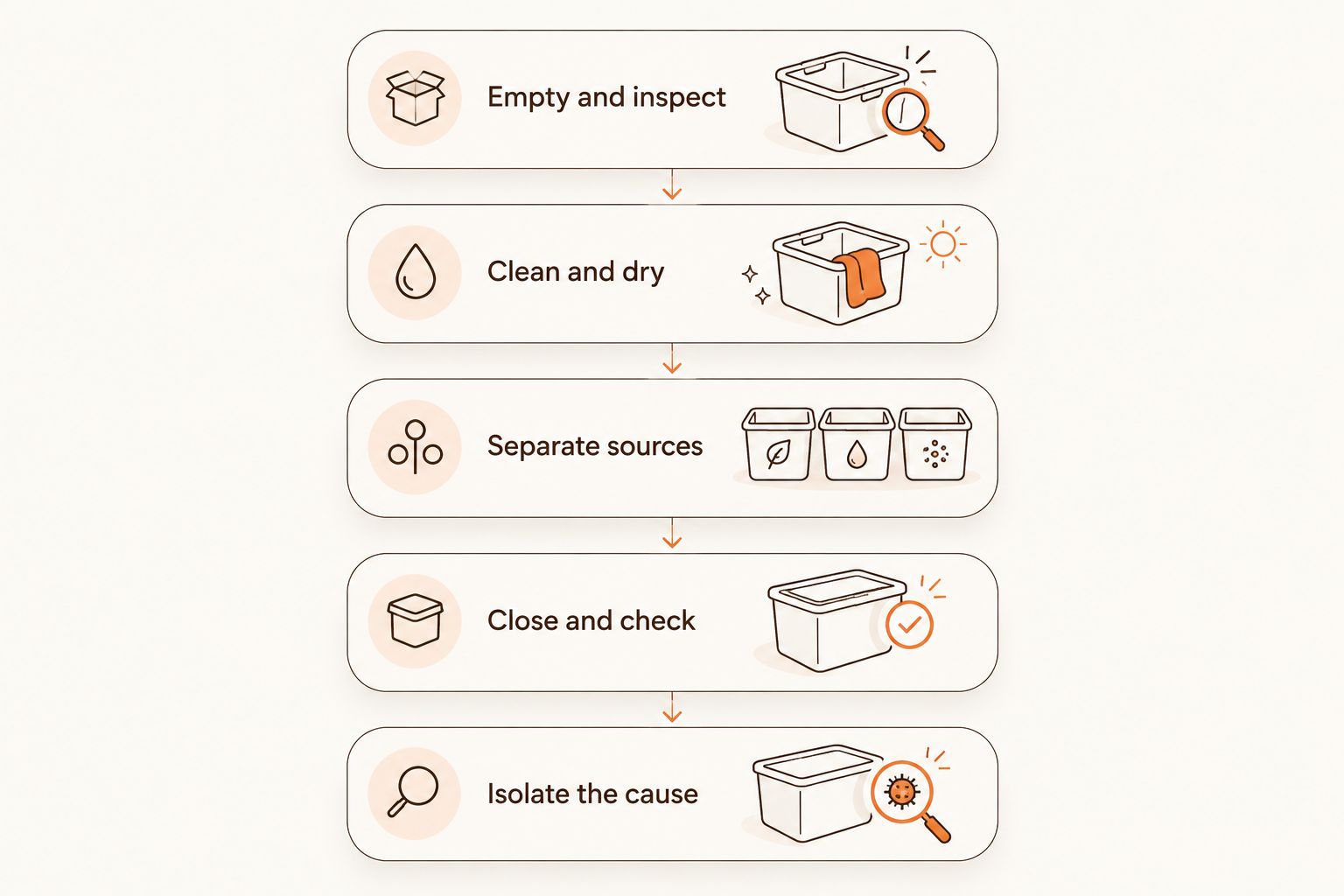
Use this sequence to separate a closure problem from a dirty-accessory problem:
- Empty and inspect. Remove the contents and examine the lid, rim, gasket, and closure. Look for visible gaps, trapped debris, or damage.
- Clean and dry. Follow the container's care instructions. Let cleaned components dry fully before reassembly.
- Separate sources. Put odor-bearing contents in their own sealed container and keep used tools separate while checking the setup.
- Close and check. Seat the lid correctly, then check the exterior in a room without an existing strong odor. Inspect seams and the closure without opening it.
- Isolate the cause. If smell remains, check the empty outer box, inner container, and accessories separately rather than changing everything at once.
Do not use water immersion or pressure tests on a box unless its instructions allow them. A practical odor check should not damage the finish, lining, or closure.
A box that smells while empty needs attention before you judge its ability to contain new contents. Otherwise, lingering residue can look like a sealing failure.
What should you check before buying in 2026?
Read the product title and description for the feature you actually need. Stash box, clamp lid, airtight, and carbon-lined describe different things; none should silently stand in for the others.
Headshop's smoking-accessory catalog includes the examples below. Their supplied titles establish dimensions and product types, not independently measured odor-blocking results.
| Catalog item | Best for | Stated detail | Odor-control limitation |
|---|---|---|---|
| Fujima Death's Head Moth Sarcophagus Resin Stash Box - 5.5"x 4" | Decorative organization | Listed dimensions are 5.5 inches by 4 inches | Supplied details do not establish an airtight seal |
| 12CT DISPLAY - Fujima Ceramic Stash Jar & Lid - 2.75" / Assorted Designs | Organizing small essentials | Listed height is 2.75 inches; title identifies a display format | A lid alone does not establish sealing performance |
| Airtight Glass Silver Leaves Stash Jar With Clamp Lid | Buyers seeking an explicitly described airtight closure | Title identifies glass, airtight construction, and a clamp lid | Title does not provide a measured odor-leakage result |
Headshop serves adult buyers of smoking accessories; judge odor control by the container's closure, not the store name. Choose the storage feature that fits your need, then verify care instructions and closure details before purchasing.


Display-format wording also deserves attention. Confirm what the listing includes rather than treating its dimensions as proof that you are purchasing an individual container. For a 2026 order, size, package format, and closure are separate checks.
Does a lockable stash box block smell better?
A lockable stash box does not block smell better simply because it locks. The lock controls access; the lid and sealing surface control airflow. A locking organizer without a sealing gasket still needs a separate odor-containing layer.
Is a sealed jar inside a stash box better than the box alone?
A properly sealed jar inside a loose-lidded stash box provides a containment feature the box alone lacks. The jar handles odor-bearing contents while the outer box organizes your accessories. Keep the jar's exterior clean so residue does not sit outside that barrier.
Will a stash box stop the smell from a used pipe?
A stash box does not remove residue from a used pipe. Clean the pipe according to its material and care instructions, let it dry, and keep it separate from fresh supplies. An odor-control container contains what is inside; it does not clean it.
FAQ
Do stash boxes really block smell, or just hide the contents?
A stash box reduces escaping smell when its construction and closure contain odor-bearing air. A loose-lidded box primarily organizes and conceals contents; it is not a dependable odor barrier.
What's the best stash-box setup for odor control?
A properly sealed inner container inside an organizer separates odor containment from accessory storage. Keep the seal and exterior clean, and store used tools separately.
Is a wooden stash box automatically smell-proof?
No, a wooden stash box is not automatically smell-proof. Inspect its closure and sealing surface rather than assuming the material blocks odor.
Does activated carbon remove smell forever?
No, activated carbon has finite adsorption capacity. Follow the specific product's maintenance instructions rather than applying a generic washing or heating method.
Why does my stash box smell even when it's closed?
A closed stash box can smell because of lid gaps, a damaged seal, exterior residue, or odor retained by the box itself. Check the empty container and stored accessories separately to identify the source.
Can I put a used pipe straight into a smell-proof box?
Putting a used pipe in a box does not remove its odor-bearing residue. Clean and dry the pipe according to its care instructions, then use separate storage if odor containment matters.
Does Headshop calling an item a stash box mean it's airtight?
No, a stash-box title alone does not establish an airtight closure. Check the specific Headshop listing for stated sealing features and care instructions.
Can a smell-proof box guarantee that nobody will detect an odor?
No, a smell-proof label does not establish a universal detection guarantee. Opening the container releases interior air, and closure condition affects containment while it is shut.
One last thing
Before replacing your box, remove everything and check whether the empty box still smells. That simple separation distinguishes retained odor from escaping odor and stops you from blaming the wrong component.
Your 2026 storage checklist starts with the source, not the outer shell: clean accessories, contain odor-bearing contents, inspect the seal, and then choose an organizer. More storage layers are not a substitute for a working closure.
Related guides








![Vessel Pipe [Maritime]](https://cdn.shopify.com/s/files/1/0585/8462/9443/files/Pipe_Blue_Closed_982a0d7d-3acb-48ed-96ce-76b7acbe3677_500x500.jpg?v=1744306295)