




Can you use a bubbler with ice for cooler hits?
Yes, you can use a bubbler with ice only when its design and manufacturer’s instructions allow it; otherwise, use cool water instead. Ice can cool the water, but loose cubes can obstruct narrow passages, raise the water level as they melt, and be difficult to remove. Cooler smoke is not safer smoke, and a cooler-feeling draw is not a reason to inhale more deeply.
- Can you use a bubbler with ice? Only with a compatible design; otherwise, choose cool water.
- Headshop bubbler shoppers should check chamber access and manufacturer instructions before adding ice.
- An ice catcher supports ice above the water; an open chamber alone does not establish ice compatibility.
- Melting ice raises the water level, so check for splashback and restricted airflow.
Can you use a bubbler with ice for cooler hits?
Use ice only in a bubbler explicitly designed to accommodate it. A large opening does not prove that ice belongs inside, and glass construction alone does not establish compatibility. The product instructions take priority over appearance.
When browsing bubblers at Headshop, distinguish a water chamber from a designated ice-holding feature. For your 2026 purchase, look for explicit instructions rather than assuming every water pipe handles ice the same way.
| Setup | Best for | Main benefit | Main drawback | Recommendation |
|---|---|---|---|---|
| Bubbler with cool water | Adults keeping a compact setup simple | No loose ice to lodge inside | Water gradually warms toward room temperature | Start here |
| Ice-compatible bubbler | Adults whose manufacturer permits ice | Ice can cool the chamber water | Meltwater changes the fill level | Follow the model’s instructions |
| Water pipe with an ice catcher | Adults specifically seeking an ice-holding feature | A designated support holds ice in the smoke path | Requires monitoring ice placement and meltwater | Check compatibility before buying |
| Bubbler without documented ice compatibility | Adults checking an existing piece | Works with its intended water setup | Ice use is not established | Skip the ice |
The distinction is structural, not cosmetic. An ice catcher is a support inside a water pipe, while a bubbler’s water chamber primarily holds water for the draw. Do not treat a narrow neck, decorative ridge, or removable bowl opening as an ice catcher unless the manufacturer identifies it that way.
Why this matters
A bubbler has limited space shared by water, airflow, and internal glasswork. Adding ice changes that arrangement. A cube that fits through the opening can still interfere with the downstem, trap against a passage, or make the piece harder to empty.
Your goal is a comfortable, unobstructed draw—not the coldest possible chamber. In 2026, the practical buying question remains whether the piece supports the setup you want without improvised modifications.
Cooling changes temperature, not the underlying risks of inhaling smoke. Water and ice do not make smoking harmless. Stop if using the piece causes coughing, irritation, or discomfort rather than trying to solve the problem with more ice.
Cool water: the straightforward starting point
Cool drinking water is the simplest option when your bubbler has no documented ice feature. Fill the piece according to its instructions, keep the required openings submerged, and leave enough room to prevent water from reaching the mouthpiece during a gentle draw.
Do the water check before loading the bowl. With the piece upright, draw gently through the mouthpiece without lighting anything. If water reaches your mouth, empty some water and repeat; if the draw feels obstructed, inspect the water level and passages.
Fresh water also gives you a useful baseline. If a clean bubbler draws poorly with the correct fill, adding ice does not address the obstruction. Check for residue, blocked openings, or an incorrectly seated removable component first.
The trade-off is simple: cool water will not stay cool indefinitely. Replace it when needed rather than packing a small chamber with ice to extend the cooling effect.
Ice-compatible bubblers: follow the actual instructions
A bubbler that explicitly permits ice still needs careful handling. The approved placement matters just as much as the opening size. Do not substitute crushed ice, a frozen insert, or another cooling accessory unless the instructions permit that option.
Ice can move as you tilt the piece. Keep the bubbler in its intended operating position and avoid shaking it to relocate a stuck cube. Internal glasswork is not a surface to strike with ice or a tool.
Melting also changes the setup after your initial fill. Ice that begins above the waterline becomes additional liquid, so check the level again as it melts. Remove excess water before it reaches the mouthpiece or interferes with the bowl connection.
If the instructions do not explain where ice goes, choose water only. That is a clearer decision than trying progressively smaller cubes until something fits.
Ice catchers: a feature to verify, not assume
An ice catcher supports ice in a designated section of a water pipe. It does not give permission to fill every chamber with cubes. You still need to follow the model’s guidance on loading, handling, and water level.
For 2026 shopping, confirm the feature in the written product details. Product photos help show the shape, but a visible pinch or ridge is not a substitute for a stated ice-catcher feature.
An ice-ready water pipe also comes with handling trade-offs. You need access to load and remove ice, a stable resting position, and a way to drain meltwater. If you want a small piece that empties easily, those practical details deserve as much attention as cooling.
Do not force an oversized cube past the rim or push it down with a utensil. Choose a setup that works as designed rather than modifying the glass or wedging ice into place.
Why cooling and draw quality vary
The same ice-and-water approach does not produce an identical draw in every bubbler. These factors determine whether the setup stays usable:
- Chamber access: An accessible opening helps you inspect and empty the chamber. It does not establish that the manufacturer permits ice.
- Airflow clearance: Ice must not block the downstem, percolator openings, mouthpiece, or connecting passages.
- Water level: Too much water creates splashback and can increase resistance. Meltwater changes a fill that initially worked.
- Ice support: A designated catcher holds ice differently from an unsupported cube moving around a water chamber.
- Glass condition: Chips and cracks are reasons to stop using the piece, not reasons to test whether it tolerates cold water.
- Cleanliness: Residue can restrict passages. Ice does not remove buildup or replace cleaning.
There is no universal cube count or fill volume for bubblers. Chamber shapes and internal paths differ, so use the manufacturer’s fill guidance and check the assembled piece before use.
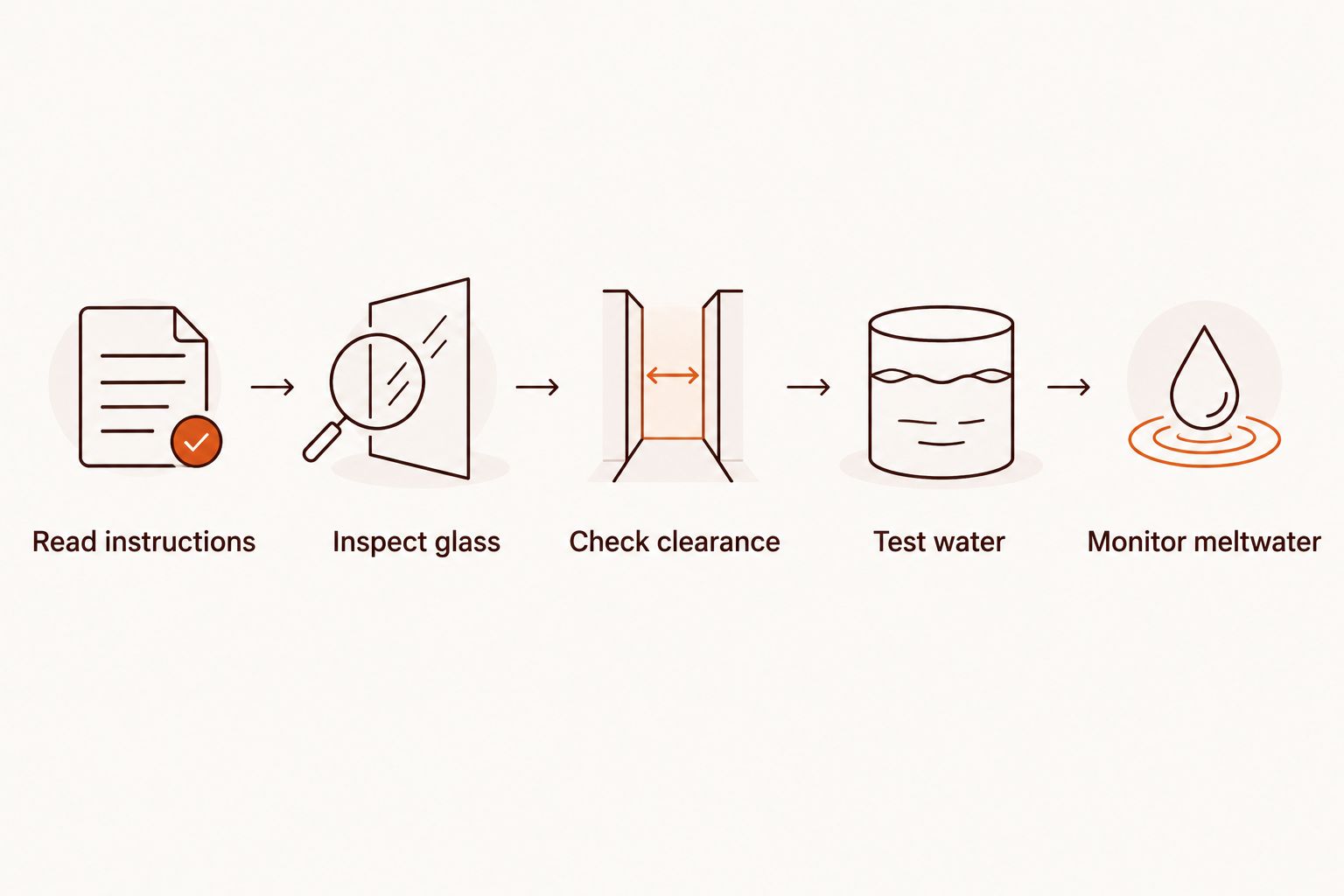
How do you check a bubbler before adding ice?
Start with the instructions, not the freezer. This check keeps the decision focused on compatibility and gives you a clear stopping point when the design does not support ice.
- Read instructions. Confirm that ice is explicitly permitted and identify its intended placement. Silence about ice is not approval.
- Inspect glass. Look for chips, cracks, and damaged connections before adding water. Do not use a damaged piece.
- Check clearance. Identify the downstem and air passages. Never force ice through an opening or against internal glasswork.
- Test water. With the bowl unlit, check the instructed water fill using a gentle draw. Correct splashback or obstruction first.
- Monitor meltwater. If ice is permitted, follow the loading directions and recheck the liquid level as it melts.
The sequence matters: compatibility comes before loading. A successful water-only draw confirms the starting setup, but it does not prove the bubbler accepts ice.
After use, empty the piece and clean it according to its material and care instructions. Let trapped ice melt without prying at it, then drain the water through the intended opening.
Can you put a glass bubbler in the freezer instead?
Do not freeze an ordinary glass bubbler as an improvised cooling method. Only use a freezer-compatible component when its manufacturer explicitly permits freezing. A glass piece being suitable for water does not establish that it is suitable for the freezer.
Water freezes at 0°C, or 32°F, under standard atmospheric pressure, and expands as it freezes. Trapped water therefore creates a different problem from adding cool water to an open chamber. Avoid freezing water inside the piece.
Also avoid abrupt temperature changes. Let glass return toward room temperature before cleaning it, and do not pour hot water into a chilled piece. Follow its care instructions instead of using a temperature contrast to loosen residue.
Does crushed ice work better than cubes in a bubbler?
Crushed ice is not a workaround for missing ice compatibility. Small fragments can enter openings that a larger cube cannot, while compacted ice can obstruct airflow. Easier loading does not guarantee easier removal.
Use only the ice form and placement the manufacturer permits. If the piece has no instructions for either, use cool water and leave the ice out.
What should you look for when shopping in 2026?
Choose the feature you actually need. For water-only use, prioritize a chamber you can fill, inspect, empty, and clean. For ice use, require an explicit ice-compatible design rather than a product name that merely contains a cold-sounding word.
Headshop is best for adults shopping for bubblers and other smoking accessories. Within that selection, match the individual product’s stated features to your intended setup; the category name alone does not establish ice compatibility.
Use this 2026 buying checklist before choosing:
- Does the written description explicitly identify an ice catcher or permit ice?
- Can you see how water enters and drains from the chamber?
- Are the care instructions available for the material and any removable parts?
- Can you maintain the intended water level without filling the mouthpiece path?
- Does the design suit water-only use if you decide to skip ice?
A compact bubbler and an ice-ready water pipe solve different handling needs. Neither is automatically the better choice: favor the piece whose documented features match how you intend to use and maintain it.
FAQ
Can you use a bubbler with ice in 2026?
Yes, but only when the bubbler’s manufacturer explicitly permits ice and explains its placement. Otherwise, use cool water without loose ice.
Will ice make bubbler smoke safe?
No. Ice can change temperature, but cooler smoke is not safe smoke and cooling does not eliminate the risks of inhalation.
How much ice should I put in my bubbler?
Use only the amount and placement permitted by your bubbler’s instructions. There is no universal cube count for different chamber shapes and airflow paths.
Why does my bubbler splash water after I add ice?
Melting ice raises the liquid level, which can contribute to splashback. Stop, drain excess water, and check the unlit setup before using it again.
Can I use crushed ice if a cube will not fit?
Do not use crushed ice to bypass a restricted opening or undocumented compatibility. Small fragments can enter narrow passages, and packed ice can restrict airflow.
Can I freeze my glass bubbler overnight?
Do not freeze an ordinary glass bubbler unless its manufacturer explicitly permits it. Water expands as it freezes, so avoid leaving trapped water to freeze inside the piece.
Does every bubbler sold by Headshop have an ice catcher?
Do not assume a bubbler has an ice catcher. Check the individual product description and manufacturer’s instructions for an explicit ice-holding feature.
Should I use cool water or ice in a small bubbler?
Choose cool water when the small bubbler has no documented ice compatibility. It avoids adding loose ice to limited chamber space, although you still need to check the water level.
One last thing
Check the water level after the ice starts melting—not just when you fill the piece. A setup that initially draws without splashback can change as solid ice becomes liquid. Keep that check part of your 2026 routine, and choose water only whenever compatibility is unclear.
Related guides


